Taiwan
Donggang King Boat Ceremony 2027: triennial rite, expected in autumn
At a glance
- Dates
- Next dates to be announced
- Where
- Donglong Temple, Donggang; the boat burns at Zhenhai Park beach
- Getting there
- Train to Nanzhou or Linbian on the Pingtung Line, then by road
- Cost
- Not listed
- Limits
- Do not enter the ritual area; follow temple staff directions
The 2024 edition has passed · Next dates will be added once announced
Dates last checked: 14 October 2026
The festival
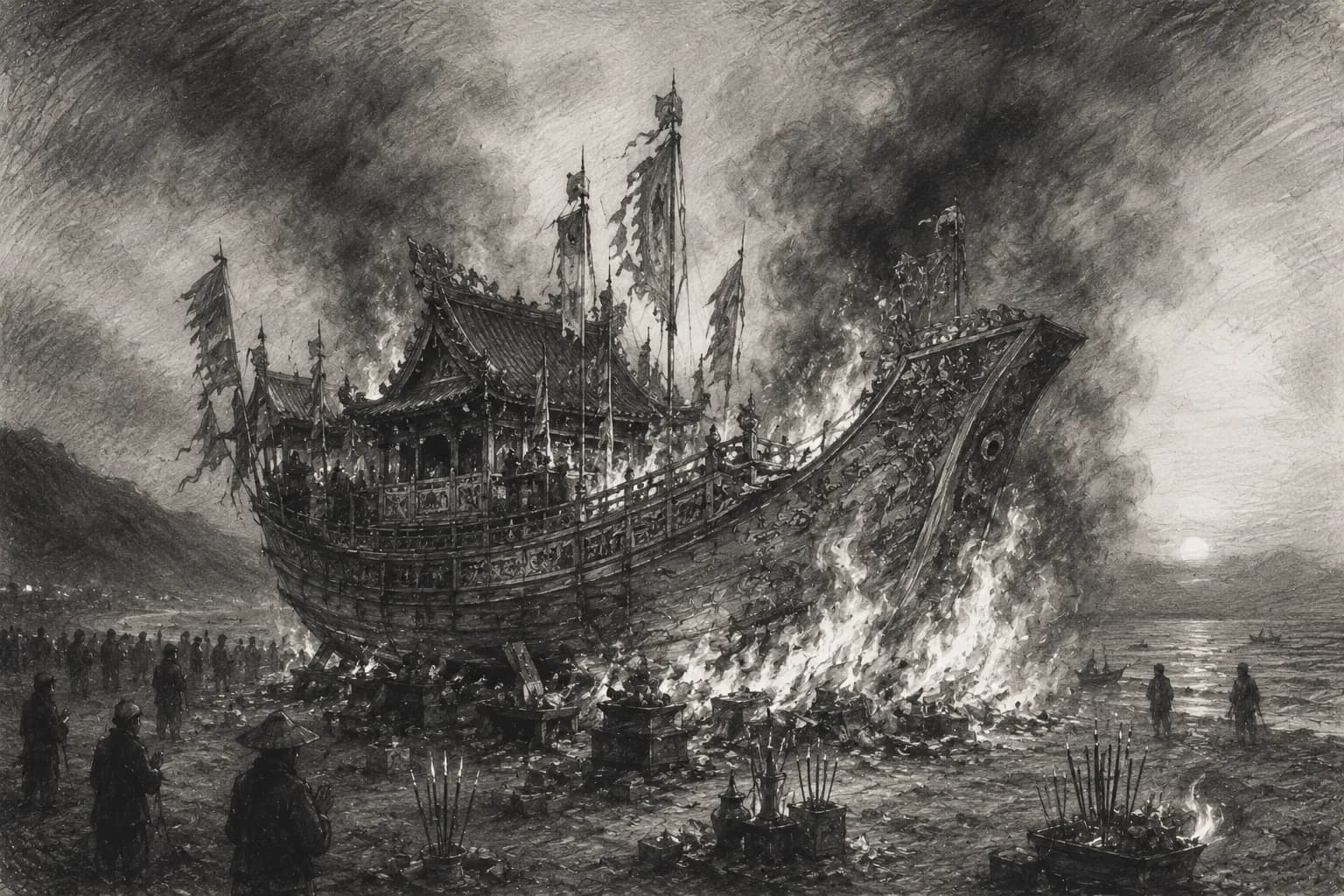
A boat 46 Taiwanese feet long ends its life as ash on Zhenhai Park beach
The boat for the coming edition was built without pay by 76 boatbuilders and volunteers from Donggang and Liuqiu. From the start of work to the last coat of paint took close to a year, of which the woodwork itself took about three months and the painting about two. Built for the 2027 Dingwei edition, it is 46 Taiwanese feet 6 inches long and was consecrated at Donglong Temple at 9:15 am on 8 July 2026.
Donglong Temple's main deity is Lord Wen, whose name sounds like the word for plague. The Royal Lords tour on heaven's behalf: during the ceremony they are welcomed into Donggang and worshipped, then sent away with the boat, taking plague and bad luck out of town.
The eight days begin with the water-fetching rite. On the first day of the 2024 edition, Donglong Temple and Donggang's seven neighbourhood associations welcomed the Royal Lords at Zhenhai Park on the southwest shore. On the eighth day the boat returns to the same beach.
Booking
These are affiliate links: if you book through them, VoucherData may earn a commission. You pay the same price.
Prices and ratings checked 13 Oct 2026
Transport
Donggang, Pingtung
Donggang–Xiaoliuqiu round-trip ferry
Ferries leave from Donggang pier, so Xiaoliuqiu fits around the festival. You must exchange for paper tickets, and the return leg must be used within 7 days.
from NT$385
See plans
Tickets and tours
Xiaoliuqiu, Pingtung
Xiaoliuqiu glass-bottom boat & semi-submarine
A 40-minute glass-bottom semi-submarine ride to see the reef without getting wet; with luck, green sea turtles too.
from NT$375
See prices
Details
Dates are set only after Donglong Temple's divination, usually for the autumn, and the 2027 edition has none yet. The boat burns late on the eighth night into the small hours, and Donggang has no railway station, so staying in town is easiest.
How the dates are set
The ceremony is held every three years, in the years of the Ox, Dragon, Goat and Dog. The next one is the 2027 Dingwei edition.
The dates are announced after the temple chairman casts divination blocks, and they land on different calendar dates each time: 28 October–4 November in 2018, 28 September–5 October in 2024. The 2024 dates were set in the 11th lunar month of the year before. Until the 2027 dates are out, an autumn weekend is the best guess.
Getting there: nearest stations and Kaohsiung
Donggang has no railway station. The nearest are Nanzhou and Linbian on the Pingtung Line, from where you continue by road. Kaohsiung also works as a base.
Traffic is heavy and parking is hard during the ceremony, so allow extra time. Ferries also run from Donggang to Xiaoliuqiu if you want to add the island.
Late nights and big crowds
The boat burning is a ritual, not a stage show, and it happens between late night and the small hours. The boat is moved after dark, the 2018 procession was still going after 1 am, and only then was the fire lit on the beach. The temple estimated 30,000 to 40,000 people on the shore that night, so expect a late night, long hours on your feet and tight crowds.
Lodging and costs
The send-off runs from late night into the early hours, so staying in Donggang saves a night-time drive. If Donggang is full, stay in Kaohsiung and allow for the drive and for finding parking.
The main costs are transport and lodging. Once the dates are out, confirm the send-off day first, then decide where to sleep the night before.
Etiquette at the boat burning
This is a religious rite, not a show. Donglong Temple and local worshippers organise it, so follow the directions of the temple and its volunteers on where to stand and which lines not to cross.
Stay out of the ritual area. During the 2018 send-off a visitor walked into it and upset worshippers. When people kneel or hold incense towards the boat, don't stand in front of them or photograph them at close range.
Safety on the beach at night
There is a lot of paper offering and open fire around the boat, so keep to the distance the volunteers set.
Agree on a meeting point in case you get separated, bring a torch and a jacket, and plan your ride back, since you will be leaving in the early hours.
The eight days in order
The ceremony lasts eight days. Day one is the water-fetching rite that welcomes the Royal Lords, followed by processions and other rites, and day eight is the send-off, when the boat is burned.
The dates for each rite in 2027 will come with Donglong Temple's published schedule.
Good to know
- Cycle
- Every three years, in the years of the Ox, Dragon, Goat and Dog. There was no ceremony in 2026
- Next edition
- 2027 Dingwei edition, expected in autumn. The 2024 dates were announced after the temple chairman cast divination blocks in the 11th lunar month of the year before
- Location
- Donglong Temple in Donggang, Pingtung County, dedicated to Lord Wen. The boat is burned on the beach at Zhenhai Park
- King Boat
- The 2027 boat is 46 Taiwanese feet 6 inches long, cost about NT$13.8 million and was consecrated on 8 July 2026
- Transport
- Donggang has no railway station. The nearest are Nanzhou and Linbian on the Pingtung Line. Ferries run from Donggang to Xiaoliuqiu
- Last edition
- 2024 Jiachen edition: water-fetching rite on 28 September, send-off on 5 October, eight days in all
- Send-off crowd
- At the 2018 send-off, the temple estimated 30,000 to 40,000 people on the beach
FAQ
4
How often is the King Boat burned?
Every three years, in the years of the Ox, Dragon, Goat and Dog. It is not an annual event.
How do you get to Donggang?
Donggang has no railway station. The nearest are Nanzhou and Linbian on the Pingtung Line, from where you continue by road; the Donggang bus transfer station, opened in January 2024, brings 21 routes together. Kaohsiung also works as a base. Traffic is heavy during the ceremony, so allow extra time.
Where is the boat burned?
On the beach at Zhenhai Park in Donggang. The boat is moved there from the Donglong Temple grounds, and in 2024 the opening water-fetching rite was held at Zhenhai Park too.
What etiquette applies at the boat burning?
It is a religious rite, not a show. Stand where Donglong Temple and its volunteers direct you, stay out of the ritual area, keep your distance from the fire, and don't photograph worshippers at close range.
Read next