TRIPS
Editor's PickBoon Khao Pradap Din
Trip Brief
Boon Khao Pradap Din is a traditional merit-making festival of the Isan region in northeastern Thailand, in which worshippers place leaf-wrapped food on the temple ground at dawn, dedicating it to deceased relatives a…
Quick Read
Trip Snapshot
- 01
Boon Khao Pradap Din is a traditional merit-making festival of the Isan region; at dawn worshippers place food wrapped in banana leaves on the temple ground, quietly dedicating it to deceased relatives and lonely spir…
en.wikipedia.org - 02
This festival takes especially to heart "those whom no one remembers"; the offering need not be abundant, for what matters is the very intention of "still remembering."
en.wikipedia.org - 03
It takes place before dawn at temples across the Isan provinces, with no purchase or reservation needed; the most important preparation is to rise early and bring a quiet heart.
en.wikipedia.org
A meal you set out before the sky has even lightened — the Isan people use a dawn meal to softly tell the dead, I still remember you.
What is Boon Khao Pradap Din? Why is the food placed on the ground?
Boon Khao Pradap Din is a traditional merit-making festival of northeastern Thailand's Isan region, when worshippers place leaf-wrapped food offerings on the temple grounds at dawn, dedicating merit to deceased kin and ownerless wandering spirits.
I stood outside the temple watching it all: the sky still dark, the air holding the cool of dew and the damp of earth, and already people were crouching on the ground, carefully setting out little parcels of rice and dishes wrapped in banana leaf — at the foot of walls, under trees, by the edges of stone steps — the leaves glistening, soaked with morning dew. No one spoke, only the soft knock of bamboo baskets, the rustle of leaf parcels opening, and a cockcrow or two far off. Watching these portions of food laid one by one along the ground, a quiet line in the faint light, one suddenly understands: they are not food for the living.
When is Boon Khao Pradap Din held? How do you work out the shifting Buddhist-calendar date?
Boon Khao Pradap Din falls in the 9th lunar month (around August–September of the solar calendar), about a month after the Rains Retreat. It is not a fixed solar-calendar date but a shifting day reckoned by the Thai lunar (Buddhist) calendar — varying each year with the phases of the moon.
So the way to work it out is: first confirm the day the Rains Retreat (the start of the vassa) begins that year, then count about a month onward, landing around the fourteenth of the ninth lunar month — that is this festival. For this reason, the exact date follows the Thai lunar calendar each year, so go by official announcements; do not take one year's solar date and apply it to the next. If you plan to go, the safest approach is to check the local temple's or provincial authorities' announcements before you set out.
Why dedicate merit to the dead on this day? What is the legend behind it?
Boon Khao Pradap Din is the Isan people of northeastern Thailand's way of dedicating merit to the dead. Legend says that on this day the gates of hell open, and departed kin, hungry ghosts, and all the lonely souls no one offers to, return to the world.
So before dawn people set little parcels of food on the ground and under trees, so that all may receive a share. This festival takes especially to heart "those whom no one remembers" — the offering need not be lavish; what matters is the very fact of "still remembering." Watching those rows of leaf parcels, I slowly came to understand: this tenderness makes no fuss, it only says, once a year with a dawn meal, softly — I still remember you.
Where is Boon Khao Pradap Din held? How do you get there?
This is a local religious custom, held mainly at temples across the provinces of northeastern Thailand's Isan region, more so in Ubon, Khon Kaen and other provinces.
It is not a large event concentrated at a single attraction, but a dawn rite scattered across temples throughout Isan. So the point of "getting there" is not some ticketed attraction, but rather: choose a provincial town in Isan and find a local temple. Ubon and Khon Kaen are both good starting points. Since the timing and scale at each temple depend on the locality, it is best, once you arrive, to confirm with the temple or with locals the time and place it will take place that day.
Who is Boon Khao Pradap Din suited to? Can you go without an offering?
If you are willing to rise early and want to encounter, on your travels, a stretch of quiet and sincere local faith, this dawn will suit you well. It is not noisy, not a performance; it is a private moment in which local people dedicate merit to the dead.
Bringing no offering and simply standing to watch is perfectly fine too. That day I went empty-handed, and standing there, I found myself remembering the people in my own life I can never see again. If you come together with a travel companion, you will find the atmosphere here naturally brings you to quiet — no words needed, only standing together in the faint light, waiting for this dawn meal to be received. I think if you too have stood through a dawn like this once, what surfaces in your heart will likely be some face long unseen.
How do you plan this trip? Transport, where to stay, cost, do you need to book?
On timing: worshippers go to the temple to place offerings in the early morning before the sky lightens, so the core arrangement comes down to one phrase — rise early. Setting your alarm early is the most important preparation for this trip.
On lodging and transport: since the rite takes place before daybreak, staying in the town center of the province where your chosen temple is (such as Ubon or Khon Kaen) is most comfortable, sparing you a long journey in the dark. As for the route from your lodging to the temple, it is best to confirm it the night before.
On cost and booking: this is a local religious custom, held at the temple in the early morning, not a ticketed event, so there is no need to buy tickets or make a reservation. What you need to prepare is not a ticket, but a quiet heart and the resolve to rise early.
What will you see on site? What is inside this dawn meal?
The sky slowly brightens, the monks come out from the temple to chant, the low sound flooding the whole compound, covering the rustle of baskets and leaves. Dawn light falls on those rows of leaf parcels, the dew not yet dry, the whole temple as if just gently wiped over. No one weeps, no one laughs; everyone simply stands quietly.
Inside the banana leaf is glutinous rice, grilled fish and a little sweet, the scent faint, mixed into the morning mist, almost beyond smelling. A thin dog weaves slowly among the offerings, and no one drives it off — on this dawn even it seems one of the tacitly permitted guests, come to receive a share. I also saw an old woman crouching under a tree, arranging for a long time, her movements slow, as if afraid of waking someone; setting down the last parcel, she pressed her palms together and murmured a few words, unintelligible, yet plainly meant for someone not here.
What should you know about taking part in Boon Khao Pradap Din? Dress, etiquette and the culture of offering
The most important rule: please stay quiet and respect the rite. This is a solemn moment in which local people dedicate merit to the dead, not a performance, so consider yourself a quiet guest.
On the culture of offering: the offerings are food wrapped in banana leaf and laid on the temple ground at dawn, and the point has never been abundance, but "still remembering." I saw that old woman set out more portions than anyone else — perhaps more of her family have gone, perhaps she only wanted to set out a few more for the lonely souls whom truly no one remembers. Once you understand this sentiment, the way you see this gesture will change.
On discretion: because it is a private dawn rite, please lower your voice and tread softly, and take photos only on the premise of not disturbing. Leave the space to them — the ones speaking softly, speaking to someone who is not here.
Why is Boon Khao Pradap Din worth rising early for once?
Because it does something very heavy, very lightly.
It asks grief of no one, leans on no clamor to build atmosphere; it only says, once a year with a dawn meal, softly — I still remember you. When the monks' chanting floods the temple and the dawn light falls on row upon row of leaf parcels, you will find hidden in this tenderness the Isan people's way of facing life and death: taking even "those whom no one remembers" to heart.
That day I brought no offering, only stood and watched, yet on leaving I felt my heart had been gently wiped over. If you too have stood through a dawn like this once, you will likely understand — what is worth rising early for has never been some attraction, but this one sentence softly spoken through a meal: I still remember you.
Before dawn, the rice is set out on the temple ground
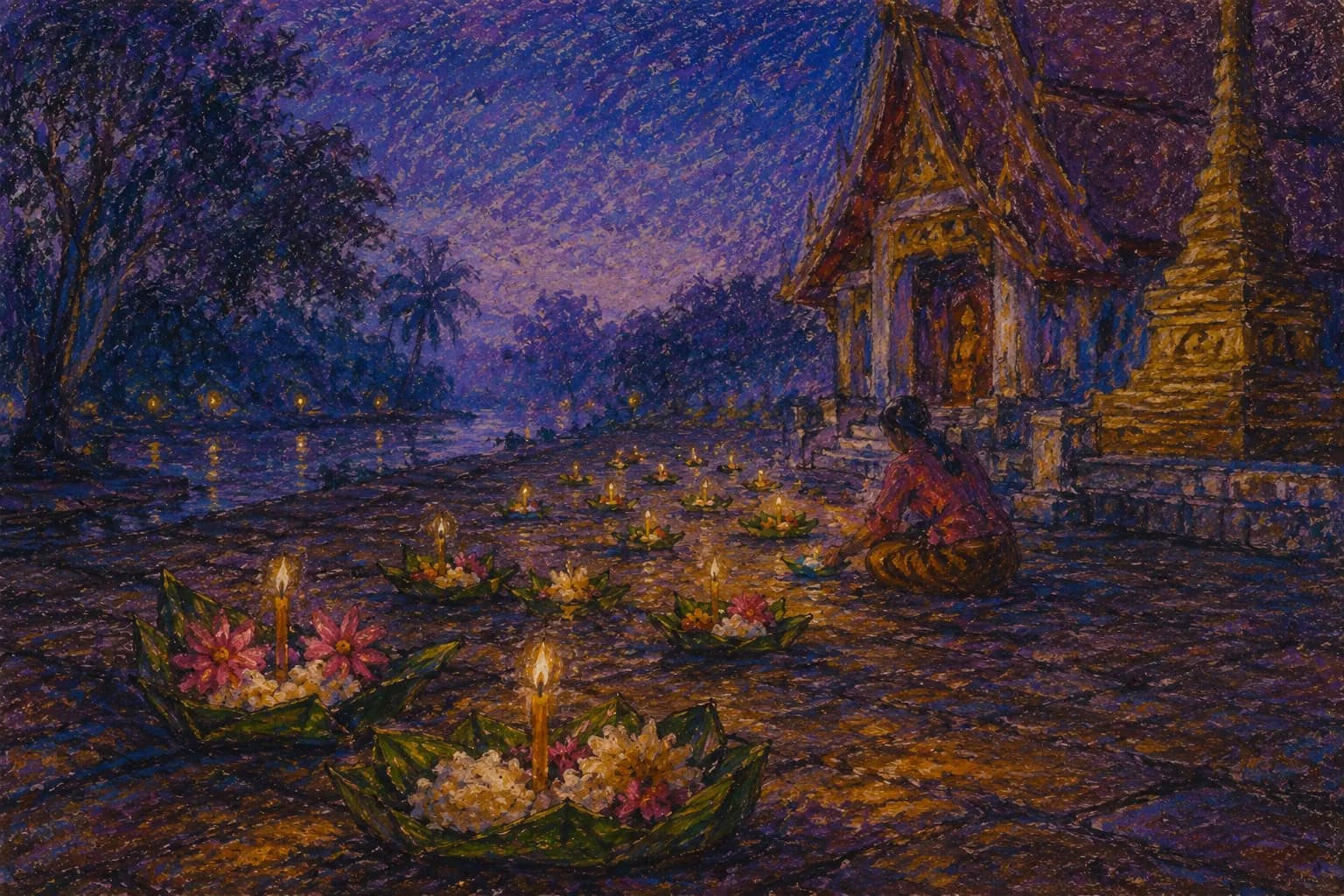
The sky is still dark, the air holding the cool of dew and the damp of earth. Outside the temple people already crouch on the ground, carefully setting out little parcels of rice and dishes wrapped in banana leaf — at the foot of walls, under trees, by the edges of stone steps — the leaves glistening, soaked with morning dew. No one speaks, only the soft knock of bamboo baskets, the rustle of leaf parcels opening, and a cockcrow or two far off. Standing aside, watching these portions of food laid one by one along the ground, a quiet line in the faint light, one suddenly understands: they are not food for the living.
Executive Summary
Date
2026-09-11 (falls in the ninth month of the Thai lunar calendar, about one month after the Rains Retreat; the exact date is set each year by the Thai lunar calendar)
Location
Temples in the Isan region of northeastern Thailand, most prominent in provinces such as Ubon and Khon Kaen
Custom
Before dawn, while it is still dark, food wrapped in banana leaves is placed on the temple ground and under trees
Meaning
Dedicated to deceased relatives and the lonely spirits no one offers to; legend says that on this day the gates of hell open and the spirits of the dead return to the world
Offering contents
The banana leaves usually hold glutinous rice, grilled fish and a little dessert; the point is not abundance but "still remembering"
Cost and reservation
A local religious custom, not a ticketed event; no purchase or reservation is needed
Trip Brief
City Routes
- Held mainly at temples across Isan provinces, more so in Ubon and Khon Kaen
- People come before dawn to place offerings — be ready to rise early
- A local religious custom — stay quiet and respect the rite
Rules
Guidelines
Check city notices, transport timing, and opening hours separately instead of relying on one source.
If a plan includes temples or formal ceremonies, follow on-site rules and local notices.
The national holiday window and city-specific extensions can differ, so confirm city timing before final planning.
FAQ
When is Boon Khao Pradap Din held?
In 2026 it falls on September 11, in the ninth month of the Thai lunar calendar, about one month after the Rains Retreat. It is reckoned by the Thai lunar calendar, so the exact date differs each year; before setting out, it is best to check the announcements of the local temple or provincial authorities.
Why is the food placed on the ground?
Worshippers wrap food in leaves and place it on the temple ground at dawn, dedicating it to deceased relatives and the lonely spirits no one offers to. Legend says that on this day the gates of hell open and the spirits of the dead return to the world to receive the offerings.
Where can Boon Khao Pradap Din be seen?
Mainly at temples across the Isan provinces of northeastern Thailand, most prominent in provinces such as Ubon and Khon Kaen. It is scattered among temples in many places, so it is best to choose a provincial city first and then find a local temple to visit.
Can I take part even without bringing an offering?
Yes. Coming empty-handed and just standing to watch is perfectly fine; this is a private moment in which locals dedicate merit to the dead, and what matters is a quiet heart.
What is usually inside the offering?
The banana leaves mostly hold glutinous rice, grilled fish and a little dessert, with a very faint fragrance. The offering need not be abundant; what matters is the very act of "still remembering."
What etiquette should I be mindful of when taking part?
Please stay quiet and respect the rite. This is a solemn, private dawn ceremony, so keep your voice low, tread softly, and take photos only without disturbing others.
Sources
Continue
More trip ideas
Tickets that may fit this trip