Essay
The dancers are fools, the watchers too — so dance

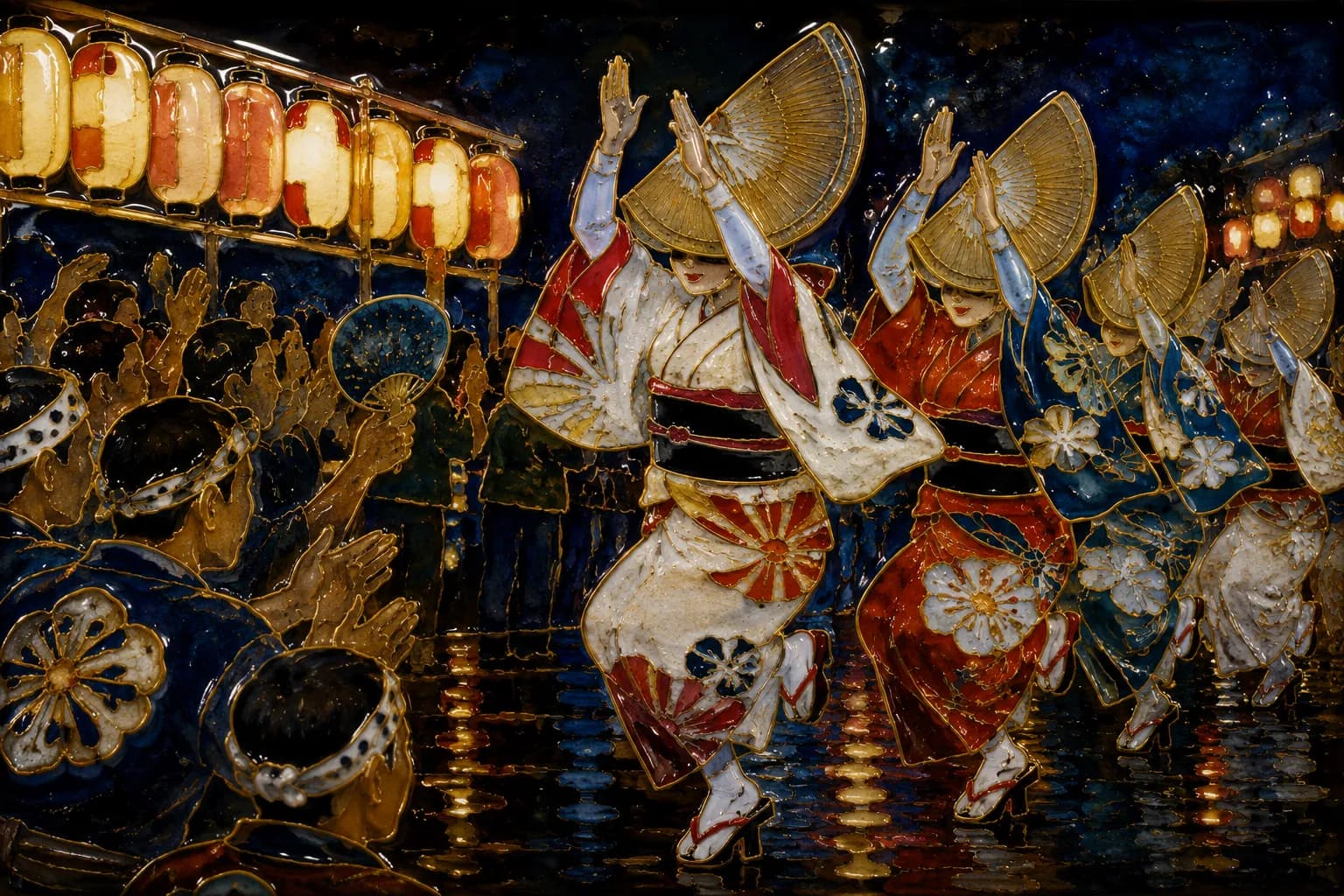
Awa Odori — one imagines neat ranks in a plaza, stepping to a beat; walk into the streets of Tokushima and it proves another thing entirely. August in Tokushima is hot and clammy, sweat clinging to the back the instant it rises and refusing to leave — yet that closeness goes unnoticed: a ren, a dance troupe, surges out from a lane-mouth, a banner ahead, shamisen and taiko behind, the sound reaching from the far end of the street before anyone is in sight, the beat arriving first. Then come the dozens — men in low, sunk steps under woven hats; women up on their toes, arms flung high, a wake of sleeves rising behind them — and the bystanders draw aside of their own accord, opening a path.
The beat is fast, and heavy: the taiko drives blow by blow into the chest until the heartbeat seems handed over to it. At some unmarked point the head is already nodding along, then the shoulders, then the whole body in motion. Awa Odori's basic steps come to only a handful — the hands, the feet, the angle of the body — yet done by dozens at once they become something else. Watching from the roadside, for an instant where one stands is wholly forgotten, drawn along by the beat alone, nothing left to think.
There are two ways to take it in: the enbujo, ticketed grandstands where troupes appear in turn and an announcer calls out each one's lineage; and the streets, free, looser, more alive, the troupes setting off from the shrine, walking and dancing as they go, a bystander pulled in now and then for a few steps, no one finding it odd. A line has been passed down here for centuries: the dancers are fools, the watchers are fools; since all are fools, better to dance together.
The line isn't cuteness; it states the heart of the thing — between performer and onlooker there was never a clear border, only something a whole city throws itself into across these few August days. As the dark comes the streets grow hotter, sweat and grill-smoke and the breath of beer all stirred together; the shamisen's high plucking darts overhead, the kane strikes the beat bright and clean, and the whole street is one vast, breathing drum. Standing within it, one can no longer tell whether the tremor rises from the ground underfoot or from one's own chest.
That night a ren simply reached out and pulled the few friends in: in the most ordinary clothes, fumbling through those few steps, clumsy, off the beat, feet in a tangle — yet not one person around laughed at anyone; they only let these outsiders become a length of the line as well. A few steps and everyone was drenched; faces under the woven hats turned and smiled, and the smiling was returned, until sides ached — that feeling of all being fools, and being foolish together, gladly, had not come along in a long while.
Once it breaks up, Tokushima falls quiet fast, the river clearing away the day's clamour as if nothing had happened, only a thread of sweat and grill-char left on the night wind. Yet the beat does not leave so easily — months later, on some unrelated afternoon, with no warning at all, it strikes up again in the head. It cannot be left behind in Tokushima. And I think you will be like us, finding one day that it had long since followed you, quietly, home.
Essay