In Erlong village the two boats race to a gong, with no drum and no winner
Related guide: Dragon Boat Festival 2027 in Taiwan
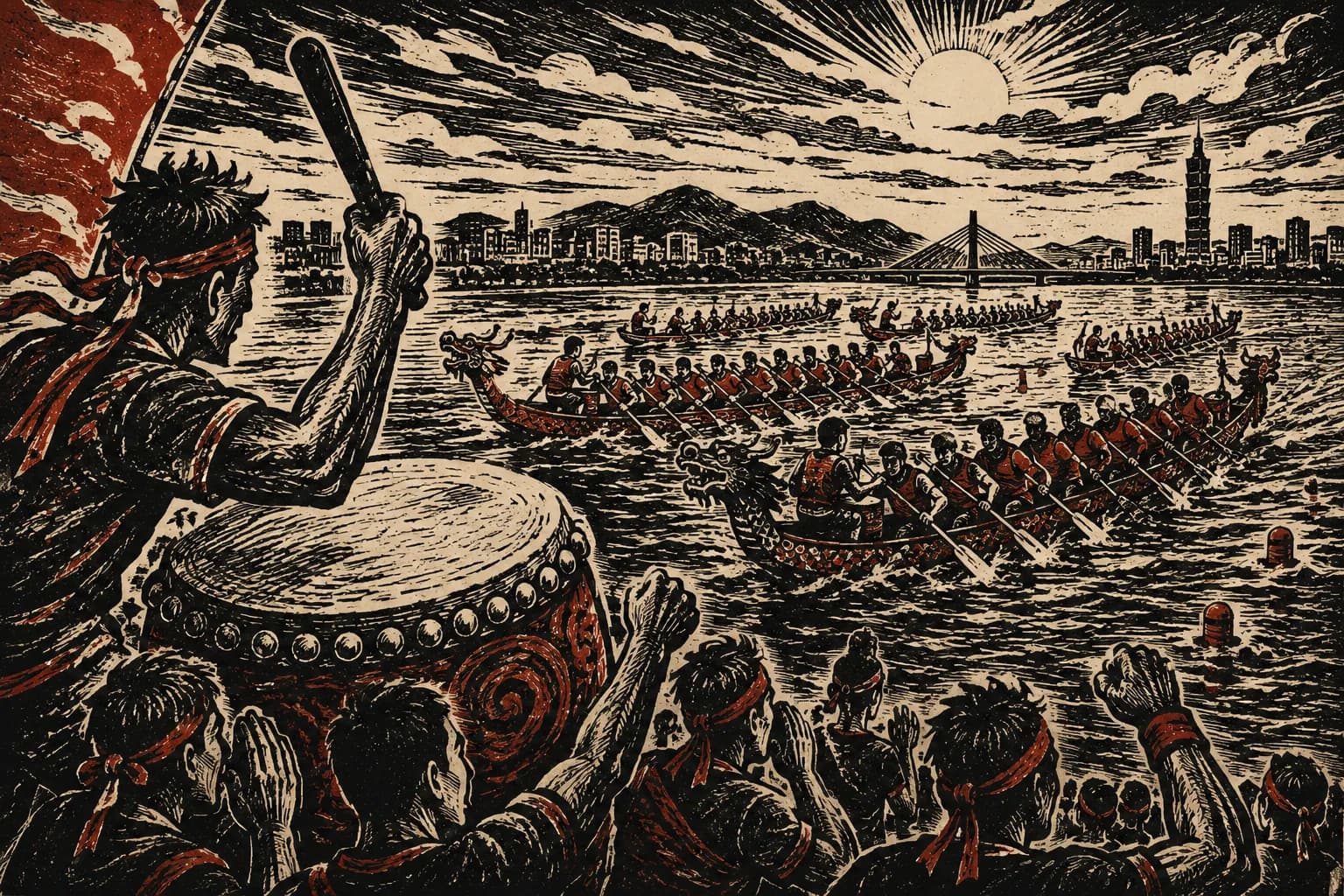
Dajia Riverside Park on the Keelung River hosts the Taipei International Dragon Boat Championships over three days; in 2026 there were 223 teams, more than 5,000 paddlers and staff, and NT$3.61 million in prize money. The organiser, the Taipei City Department of Sports, also ran egg-standing and balancing challenges and an international market on the bank.
Kaohsiung races on the Love River, which drew more than 110,000 visits over the first two days in 2026, about 10% more than the year before. The Love River also has rare night races, and Fo Guang Shan's flying-horse lanterns flew at 18:50 and 20:30.
The Lukang Duanyang International Dragon Boat Championships on the Fulu River are spread over three days: in 2026, heats on 19 June, semi-finals on the 20th and finals on the 21st, each day starting at 13:00 and running past 20:00. On the Tainan Canal the course runs from Anyi Bridge to Chengtian Bridge, with vendors and cultural activities on the bank from 15:00 to 21:00 each race day.
Duanwu has an egg-standing custom: at noon an egg is said to stand upright on its own, and in 2026 the riverside programmes in Taipei, Kaohsiung and Hualien all included egg-standing. Liyu Lake in Hualien also held a mass zongzi-wrapping for 10,000 people.
Racing dragon boats and eating zongzi are traced to the legend of Qu Yuan, a poet of the state of Chu who drowned himself in the Miluo River. The Erlong regatta in Jiaoxi, Yilan, has its own history: it has been held for more than two centuries and began as a rite for the souls of the drowned. Qiwulan and Zhouzaiwei each put one boat on the water, the crews row to a gong rather than a drum, the boats carry no dragon heads, and no winner is declared.
The full guide to this festival
Dragon Boat Festival 2027 in Taiwan: where to watch the races on 9 June
Full guide: dates, getting there and what you can book →