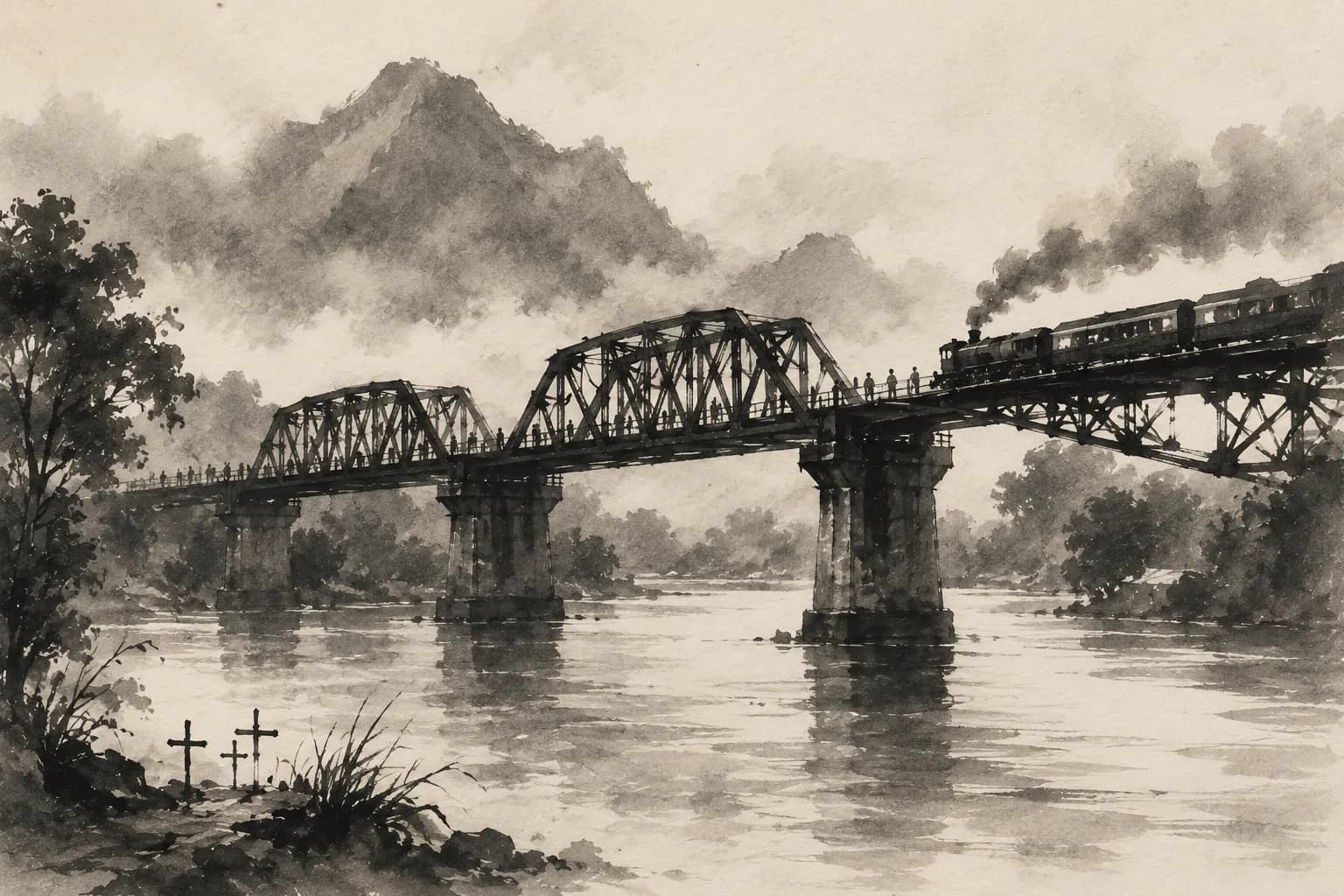
A railway built by 60,000 prisoners, retold on the bridge after dark
Related guide: River Kwai Bridge Week 2026
Each year in late November, Kanchanaburi Province runs River Kwai Bridge Week together with the Red Cross Fair, on the bridge itself and the provincial grounds beside it. The bridge belongs to the Second World War Thai–Burma Railway, the Death Railway, and ordinary passenger trains still cross it.
To open a railway from Thailand into Burma, the Japanese army forced more than 60,000 Allied prisoners of war, from Britain, Australia, the Netherlands, the United States and elsewhere, to build it in 1942 and 1943, along with an even larger number of Asian labourers: Chinese, Malay, Javanese and Burmese. Tens of thousands died of disease, starvation and exhaustion.
After dark, a light-and-sound show uses lighting, sound effects and fireworks to retell that history on the bridge. It does not run every night without fail. On two nights in early December 2025 the show was cancelled because its steam locomotive was needed for a royal duty, and an outdoor khon performance and the folk tale Sang Thong took its place.
Kanchanaburi War Cemetery (Don Rak) is maintained by the Commonwealth War Graves Commission. It holds or commemorates 5,085 Commonwealth and 1,896 Dutch servicemen, 139 of them unidentified. The Thailand–Burma Railway Centre, a museum about the line, stands next to it.
The full guide to this festival
River Kwai Bridge Week 2026: 25 November–5 December (est., TAT provisional), light and sound on the Death Railway
Full guide: dates, getting there and what you can book →
Tickets and transport you can book
These are affiliate links: if you book through them, VoucherData may earn a commission. You pay the same price.
Kanchanaburi
Death Railway & Hellfire Pass day trip from Bangkok
Hotel pick-up in Bangkok, about 12 hours, with lunch and a Death Railway ride. The tour page says its Hellfire Pass stop has been suspended since 27 September 2026 after heavy rain and is replaced by Captive Cave and Sai Yok until it resumes; the memorial centre's own opening days are set by its operator.
See pricesThailand 5G eSIM (AIS)
Unlimited data on AIS. Your phone must support eSIM; activate it in the Klook app before you fly. Full refund if cancelled before it connects.
See plans