Japan
Gion Matsuri 2027: both float processions fall on Saturdays, 17 and 24 July
At a glance
- Dates
- Next: 1–31 July 2027
- Where
- Float neighbourhoods around Shijo-Karasuma, central Kyoto
- Getting there
- Karasuma subway adds Yoiyama-night trains; Shijo buses detour (2026)
- Cost
- Not listed
- Limits
- No eating while walking or bringing bicycles in during Yoiyama
The 2026 edition has passed
Dates last checked: 14 October 2026
The festival
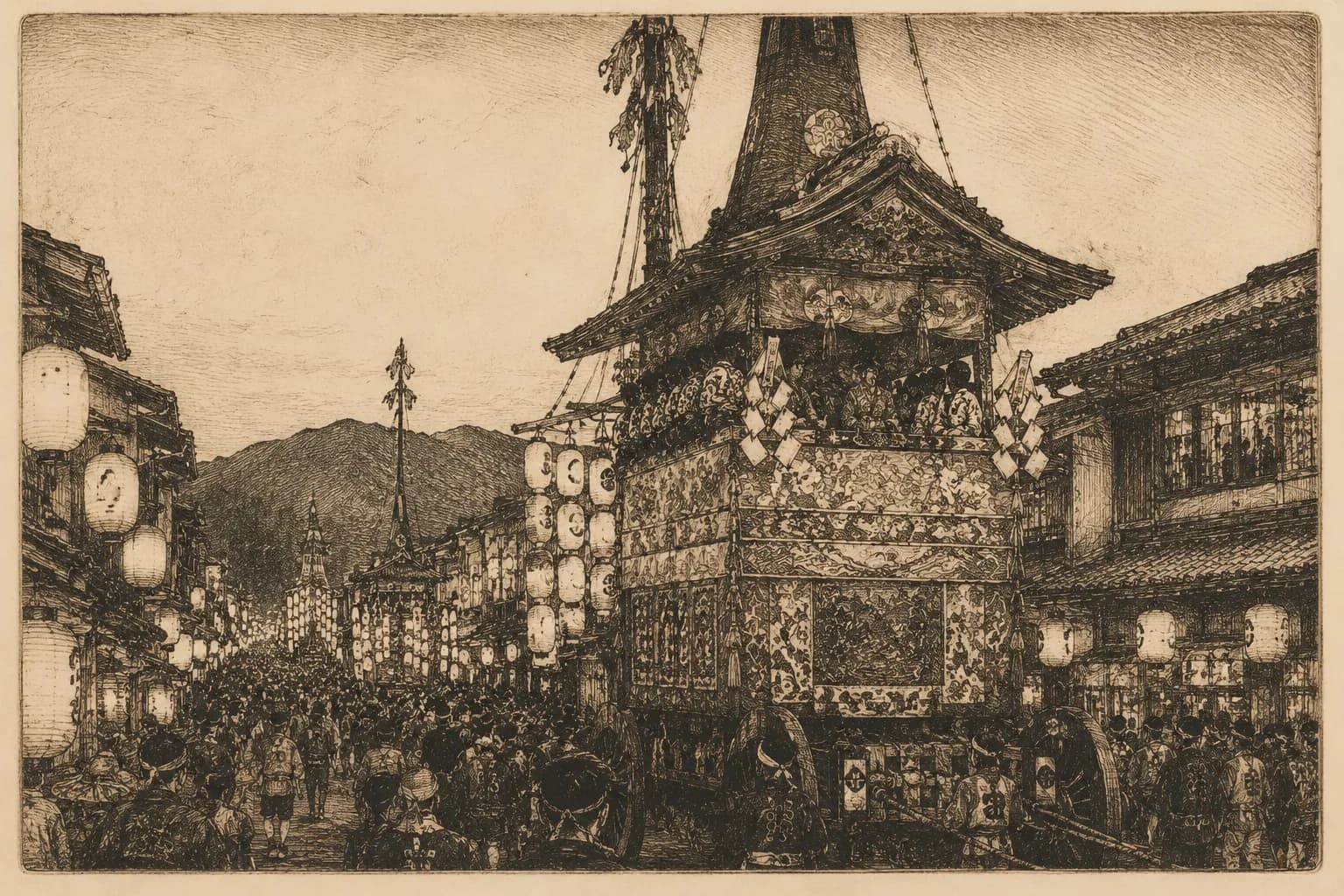
Floats weighing several tonnes, lashed with rope and not a single nail
The neighbourhoods around Shijo-Karasuma start assembling their floats on 10 July, without a single nail, lashing the timbers together with rope in a method called nawagarami. The Saki Matsuri floats go up on 10–14 July and the Ato Matsuri floats on 18–21 July. For the other eleven months they are kept in pieces in neighbourhood storehouses.
The large hoko stand over twenty metres tall including the mast, hung with layers of textiles, some of them tapestries and embroidery imported from the Middle East, Europe and China centuries ago. During Yoiyama, some old townhouses in the float neighbourhoods open their tatami rooms to show folding screens and heirlooms, a custom called byobu-kazari.
The three evenings before each procession are Yoiyama. After dark the floats are lit and musicians on board play the gongs, flutes and drums of gion-bayashi. The Saki Yoiyama has street stalls; the Ato Yoiyama has far fewer. When the area around Shijo-Karasuma gets packed, police and security staff control which way people walk.
Booking
These are affiliate links: if you book through them, VoucherData may earn a commission. You pay the same price.
Prices and ratings checked 13 Oct 2026
Transport
Kansai
JR Kansai Wide Area Pass
Five days of unlimited JR West rides across Kansai, reaching Kansai Airport, Nara, Himeji and Okayama. If you stay within Kyoto and Osaka you may not need it. Non-Japanese passport holders on temporary-visitor status only.
from NT$2,380
See plansKansai Airport, Osaka
JR Haruka Kansai Airport Express
Direct from Kansai Airport to Osaka and Kyoto, with QR e-tickets at the gates. Only for non-Japanese passport holders entering as temporary visitors.
from NT$248
See plans
Mobile data
Japan eSIM (Softbank 5G / Docomo 4G)
Runs on Softbank or Docomo in Japan; install by QR code, unlimited-data plans with a choice of days.
See plans
Details
With one day, choose a Saki Yoiyama evening to see the lit floats up close, or claim a spot early on procession morning to see the corner turns. Both 2027 processions fall on Saturdays.
Gion Matsuri 2027 dates
Gion Matsuri lasts the whole of July; it is not a one-day event, and the dates are the same every year.
The core is the Yamaboko Junko float procession, held twice: the Saki Matsuri and the Ato Matsuri, both on a Saturday in 2027. Each is preceded by three evenings of Yoiyama; in 2027 the Saki Yoiyama falls Wednesday to Friday.
One day only: procession or Yoiyama
If you only have one day: for the craftsmanship of the floats and the procession itself, go on the morning of the Saki procession, arriving early for a spot and standing in strong sun. For lit floats, street stalls and festival music, go on one of the Saki Yoiyama evenings. At Yoiyama you can walk into the float neighbourhoods; on procession day you watch from the roadside.
Paid seats and booking a room
The paid procession seats are on Oike-dori, all reserved, so you get a seat without staking out a spot at dawn. In 2026 the Saki procession had about 10,000 seats (Kawaramachi-dori to Shinmachi-dori), and the Ato procession two areas, in front of City Hall and at Karasuma-Oike, with about 2,000 each.
They are sold by the Kyoto City Tourism Association. In 2026 a lottery ran from 27 April to 6 May, and general sales opened on 1 June, online through Kyoto Sightseeing Navi (which links to Ticket Pia) or at 7-Eleven stores. Sale dates for 2027 have not been announced. Kyoto rooms get scarce from early July, so book early.
A Yoiyama walk north from Shijo-Karasuma
Yoiyama starts in the early evening. Shijo-Karasuma has the densest cluster of floats; walking north and west through the lanes from there takes you past many of them. Some floats can be boarded for a fee, which lets you see the textiles and the structure from inside.
With children, go in the early evening before it is fully dark, when the lanes are easier to walk. July evenings in Kyoto stay hot, so carry water.
What to look for: hoko, yama and tsuji-mawashi
There are two kinds of float: hoko are tall, with a real timber mast, like a moving tower; yama are smaller and carry figures or set scenes. Each belongs to a different neighbourhood and is hung with its own textiles, many of them antiques and imported pieces, which is why the floats are called moving art museums.
The moment to watch on procession day is tsuji-mawashi: the floats have no steering, so at each intersection crews haul them round by hand over wet bamboo strips laid under the wheels, and each turn takes several minutes.
Saki Matsuri vs Ato Matsuri
The Saki Matsuri has 23 floats and more spectators. The Ato Matsuri has 11, a thinner crowd along the route, and the Ofune-boko, which returned in 2014. For a first visit and more floats, pick the Saki Matsuri; if you dislike crowds, pick the Ato Matsuri. Its Yoiyama also has far fewer stalls, which suits people who want to look at the floats at their own pace.
Origins: the Heian-era Goryo-e
Gion Matsuri began in the Heian period as the Goryo-e, a rite to ward off epidemics. The floats are built and maintained by the townspeople (merchants and residents) of each neighbourhood, and the textiles they carry are collections kept by each district for generations. The procession's original purpose was to send disease out of the city in the season when epidemics spread.
Coping with the sun on procession day
Standing in the morning sun on procession day is tiring. Watch part of the procession from a shaded spot, then retreat to Nishiki Market or a nearby café for lunch and save your energy for the evening. The Kyoto City Tourism Association's Yoiyama and procession guide also asks visitors to drink often and rest when needed.
Nearby: temples, Kamogawa riverside dining, Uji and Fushimi
Beyond the festival, when the day gets too hot, temples and gardens such as Kennin-ji and Nanzen-ji are cooler places to be. In the evening, walk along the Kamo River, where restaurants set up summer kawadoko platforms over the water; with a spare day, head to Uji or Fushimi. These places are busier than usual during Gion Matsuri, so book popular riverside restaurants ahead.
Etiquette and Yoiyama rules
Most floats are designated cultural properties, so don't climb on or touch them. During Yoiyama the Kyoto City Tourism Association asks visitors not to eat while walking, not to bring bicycles into festival areas, and to follow directions from police and security staff. A yukata is optional.
Good to know
- Festival period
- 1–31 July 2027; Gion Matsuri spans the whole month and is not a one-day event. The 2026 edition took place on 1–31 July.
- Location
- Central Kyoto's float neighbourhoods, clustered around Shijo-Karasuma.
- Float processions (Yamaboko Junko)
- Saki procession on 17 July, leaving Shijo-Karasuma at 9:00 with 23 floats; Ato procession on 24 July, leaving Karasuma-Oike at 9:30 with 11 floats. From 1966 to 2013 the two were merged into 17 July, and the Ato procession returned in 2014. Both fall on a Saturday in 2027.
- Yoiyama
- Saki Yoiyama runs on the evenings of 14–16 July and Ato Yoiyama on 21–23 July. The floats are lit, and some old townhouses in the float neighbourhoods open their tatami rooms to visitors.
- Types of floats
- Floats come in two kinds: hoko, tall with a real timber mast like a moving tower, and yama, smaller and carrying figures or set scenes. Each is hung with its neighbourhood's textiles, which is why they are often called moving art museums.
- Origin
- The festival began in the Heian period as the Goryo-e, a rite to ward off epidemics. The floats show both the wealth of Kyoto's townspeople and their prayers against disease.
FAQ
3
What is the difference between the Saki Matsuri and the Ato Matsuri?
The Saki Matsuri has more floats and more spectators; the Ato Matsuri has fewer floats and a thinner crowd along the route, and includes the Ofune-boko, which returned in 2014. Both include tsuji-mawashi turns at intersections.
What is worth looking at on the floats?
The yamaboko come as "hoko" and "yama", hung with each neighbourhood's antique and imported textiles, and are called "moving art museums". During the procession, watch the "tsuji-mawashi" at intersections: crews turn the huge wheels by hand over wet bamboo strips, and each turn takes several minutes.
Where can I buy paid seats for the procession?
The paid seats are on Oike-dori, all reserved, and sold by the Kyoto City Tourism Association. In 2026 a lottery ran from 27 April to 6 May, and general sales opened on 1 June, online through Kyoto Sightseeing Navi (which links to Ticket Pia) or at 7-Eleven stores. Sale dates for 2027 have not been announced.
Read next