Japan
Kishiwada Danjiri Matsuri 2027: multi-ton wooden floats cornering at full speed, est. 18–19 September
At a glance
- Dates
- Next: 18–19 September 2027 (est.)
- Where
- Ordinary town streets in Kishiwada, Osaka Prefecture
- Getting there
- Nankai Railway express train from Namba, about 30 minutes
- Cost
- Free from the street; paid seats are sold separately
- Limits
- Viewers must stay in marked areas, clear of the float route
The 2026 edition has passed
Dates last checked: 14 October 2026
The festival
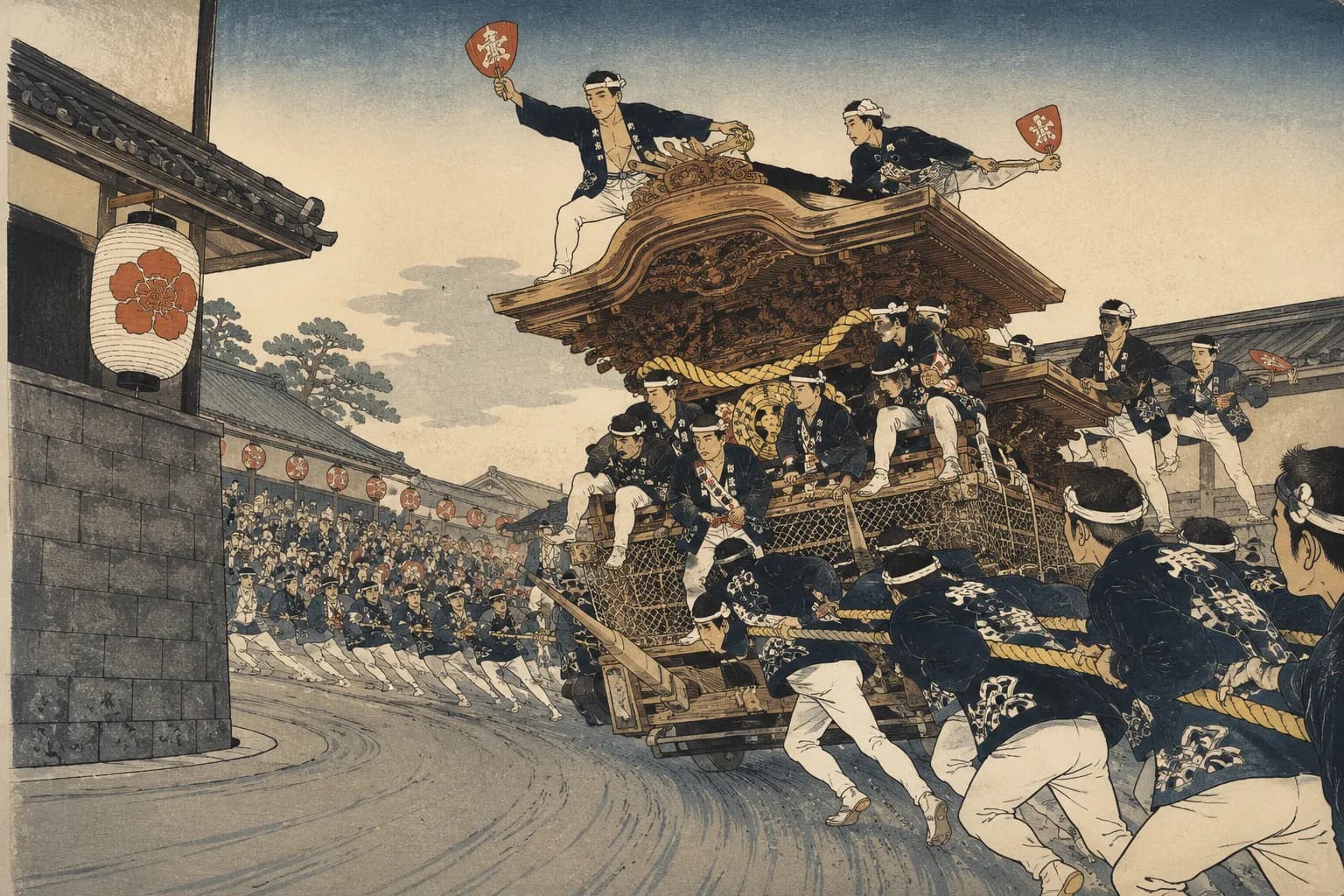
On the roof, a daikukata leaps with the float through each corner, waving a fan
Kishiwada's danjiri are hauled through the city's ordinary streets. On the yoimiya of the 2026 September festival, each neighbourhood's float was out from 6am until 10pm; on the honmiya it ran from 9am to 10pm, with times varying by district. A second round followed on 10–11 October. According to Kishiwada City, the festival began in the mid-Edo period as an Inari festival held by the lord of Kishiwada to pray for good harvests, and has more than 300 years of history.
The danjiri are built of wood and carved all over with warriors and mythical beasts. On the roof stand the daiku-gata, who leap with the float as it turns and signal with fans. Kishiwada is still hot by day in September.
The yarimawashi at street corners is the heart of the festival: the float reaches the corner without slowing, and the rope teams fore and aft pull against each other to swing several tonnes through ninety degrees at full speed. When a turn goes wrong the float can smash into buildings, and there have been deaths and injuries in the past. Each float belongs to its own neighbourhood group, and the rope teams, the daiku-gata on the roof and the people directing at the corner all have to work together.
Booking
There are no tickets or transport to book for this page right now.
Details
To see the yarimawashi, be at a corner in daylight: the high-speed turns happen by day, and after dark the floats are hauled slowly under lanterns. Popular corners fill early and mean a long wait on your feet in September heat.
Dates, and daytime versus evening
The main event is the September festival, with a separate October round. The 2027 dates have not been announced; by the custom of holding it on the weekend before Respect for the Aged Day, the estimate is 18–19 September, subject to Kishiwada City's announcement.
The fast cornering mostly happens by day. After dark the floats hang lanterns and slow down. If you can stay all day, watch the turns in daylight and the lantern runs in the evening.
Location and getting there
It takes place in Kishiwada, Osaka Prefecture, with the floats running and turning on ordinary streets.
From central Osaka, the Nankai line takes about 30 minutes (express from Namba), so it fits easily into a day trip.
Houses and shops line the route, so find a marked viewing area when you arrive before choosing where to stand.
Waiting at the corners
Hauling starts at 6am on the yoimiya, September days are still hot, and the popular corners mean arriving early and standing for a long time. Corners are no place for toddlers in strollers or anyone who can't stand for hours; the slower lantern runs in the evening are an easier alternative.
Transport, where to stay and costs
Transport: the simplest plan is to base yourself in central Osaka and ride the train to Kishiwada and back. Stations and trains are crowded during the festival, so allow more time than usual.
Where to stay: central Osaka has the most choice and the easiest transport. If you want to see the early-morning or late-night runs without the commute, look for rooms around Kishiwada early, since there are few during the festival.
Costs: watching from the street is free. For a seat, TryHard Japan sells paid seating around Kankan-ba; in 2026 it went on sale on e+ (eplus) on 3 July, with three cash-only sale days in Kishiwada in August, and tickets can't be refunded or exchanged.
Where to watch
The core of the spectacle is the yarimawashi at street corners, and the corners are both the closest view and the riskiest spot. Stay inside the marked viewing areas and don't cross the safety line for a better angle.
Viewing areas on straight stretches give a better look at the whole float and the daiku-gata on the roof. The paid seats around Kankan-ba save you from holding a spot.
Safety
The danjiri weigh several tonnes yet are hauled at a run, then swung hard at corners; when a turn goes wrong the float can hit buildings, and there have been deaths and injuries in the past.
Stay well clear of the route the whole time, keep to the marked areas, and keep track of children and bags. Once a float gets going it is fast, and there is no room to step aside at the last second.
Do what the festival staff tell you: they know when a float is about to come through and where people need to move back.
Crowds and etiquette
The popular corners get very crowded. Arriving early and settling into a spot inside a viewing area is safer than moving through the crowd, and your view is less likely to be blocked.
Each float is run by its neighbourhood group, generation after generation. Don't cross the safety line for photos, don't block the rope teams or work paths, and don't touch the floats or ropes.
How the floats are built
Each danjiri is built entirely of wood with mortise-and-tenon joints and carved all over with warriors, mythical beasts and story scenes, and is made and repaired by specialist craftsmen.
At the corners in daytime the floats move too fast to see the carvings. For the details, look from a viewing area while a float is parked between runs.
Good to know
- When
- The September festival ran on 19 September (yoimiya) and 20 September (honmiya) in 2026. A separate October round ran on 10–11 October 2026. Hauling times vary by district.
- Where
- Kishiwada, Osaka Prefecture. The floats run and turn on ordinary town streets, not in a closed venue.
- Highlight
- The floats are whipped around street corners at high speed (yarimawashi), wrenching the multi-ton carts through ninety degrees at full speed, mostly by day
- Access
- About 30 minutes (express from Namba) from central Osaka on the Nankai line; a day return is far from a stretch
- Craft
- Each float is built of wood with traditional joinery and covered in carvings of warriors and mythical beasts, made and repaired by specialist craftsmen
- Paid seating
- Watching from the street is free. A private company, TryHard Japan, also sets up paid seating around the Kankan-ba corner; in 2026 tickets were sold on e+ (eplus).
FAQ
5
How do you get to the Kishiwada Danjiri Matsuri from Osaka?
It takes place in Kishiwada, Osaka Prefecture, with the floats running and turning right on the town's streets. From central Osaka it's about 30 minutes on the Nankai line.
What is the main thing to watch?
The heart of the spectacle is the floats whipped around street corners at high speed (yarimawashi); the rope-pullers fore and aft offset their force to wrench the multi-ton cart through ninety degrees at full speed, mostly by day.
What's the difference between the festival by day and by night?
Daytime is when the high-speed cornering happens. After dark the floats hang lanterns and move slowly; in 2026 both days ran until about 10pm.
How do you stay safe while watching?
The floats weigh several tonnes and are hauled at a run, so stay well clear of the route, keep to the marked viewing areas, keep track of children and bags, and do what the festival staff tell you.
Do you need a ticket, and where can you buy a seat?
Watching from the street is free. For a seat, a private company, TryHard Japan, sets up paid seating around the Kankan-ba corner: in 2026 it had a hill-side area (the Co-op Kishiwada car park) and a sea-side area (Kankan Bayside Mall), sold on e+ (eplus) from 3 July, plus three cash-only sale days in August. Sales details for 2027 have not been announced.
Read next