The procession leaves the Imperial Palace in the morning and reaches Kamigamo by afternoon
Related guide: Aoi Matsuri 2027
The Roto-no-gi procession of Aoi Matsuri is 511 people, 36 horses, 4 oxen and 2 ox carts, stretched over about a kilometre. It leaves the Kyoto Imperial Palace in the morning, enters Shimogamo Shrine around midday and follows the Kamo River north to Kamigamo Shrine in the afternoon. Aoi Matsuri falls on the same date every year, moving back a day if it rains, and it is the oldest of Kyoto's three great festivals, alongside the Gion Matsuri and the Jidai Matsuri.
The festival dates to the sixth century under Emperor Kinmei, when storms and failed harvests led the court to hold rites to appease the Kamo deities. That was the start of the Kamo Festival, and from 807 it was led by an imperial envoy. Because hollyhock leaves decorate the shrine buildings, carts, costumes and animals on the day, it came to be called the Aoi (hollyhock) Matsuri.
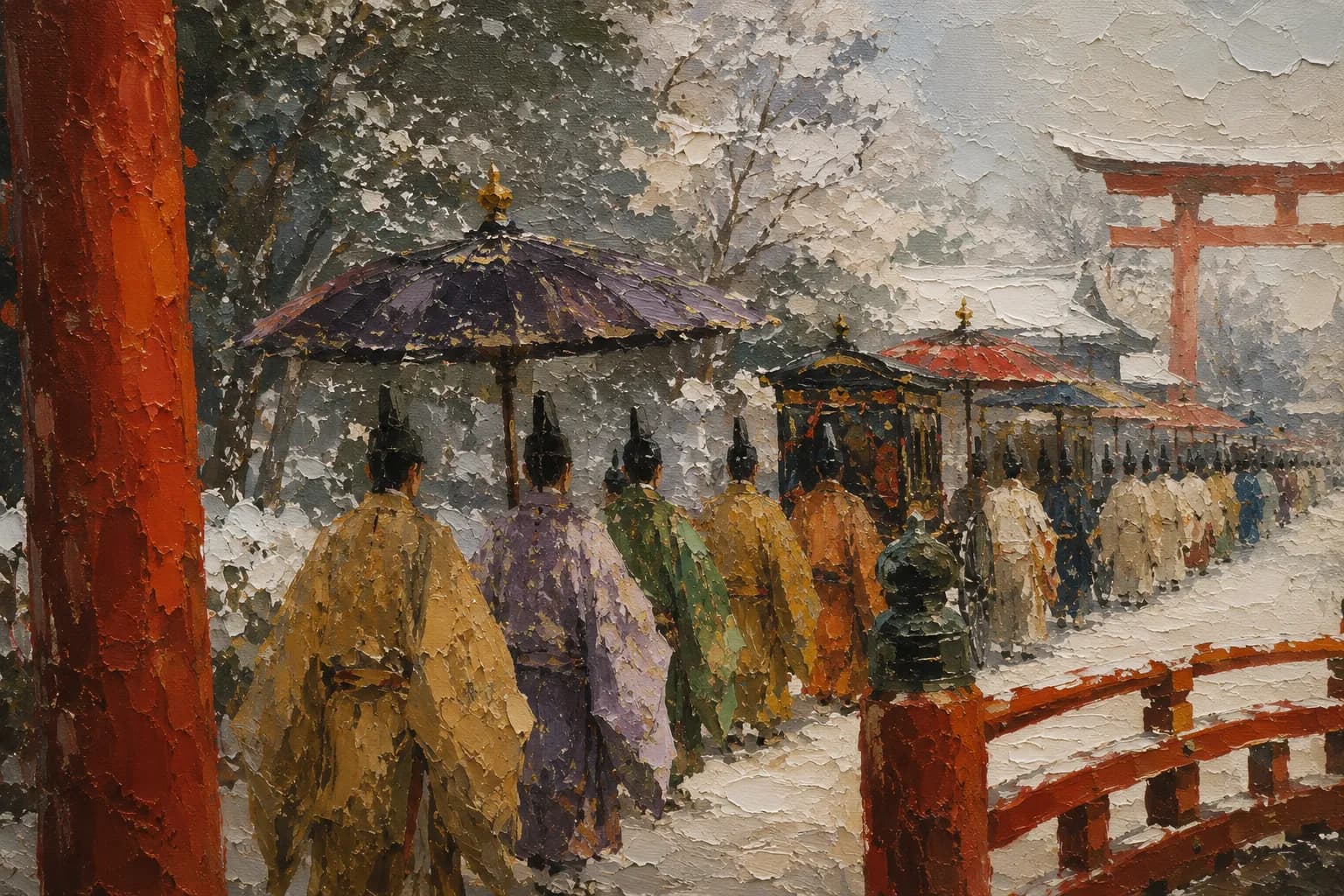
The procession includes court officials on horseback, attendants on foot and ox carts decorated with hollyhock, their robes layered in blue, scarlet and deep purple. Everyone wears aoi-katsura on their headgear and chest, and it hangs from the cart eaves too: twin hollyhock leaves wound on a katsura sprig, the crest of the Kamigamo and Shimogamo shrines. Oxen pull the carts on wooden wheels, and the whole procession moves at walking pace.
Near the back comes the Saio-dai, the festival's female lead, carried in a palanquin and attended by court ladies. The Saio were imperial princesses who served the Kamo shrines, a role that lasted nearly 400 years until the mid-13th century, and the Saio-dai recreates it today. The whole procession takes about an hour to pass any one point, and the Saio-dai follows the mounted officials.
Most of the route is free to watch. Mid-May afternoons in Kyoto are warm, and the Kamo River embankment has no shade. Later in the afternoon, the head of the procession passes under the torii of Kamigamo Shrine for the day's last rite, the Shato-no-gi.
The full guide to this festival
Aoi Matsuri 2027: Kyoto's Heian-era procession on 15 May
Full guide: dates, getting there and what you can book →