Kinmen's kitchen knives are forged from propaganda shells
After the 1958 bombardment the mainland shelled Kinmen only on odd-numbered days, a pattern that lasted until 1979.
Much of the steel in Kinmen's forges comes from shells fired during the 1958 bombardment, known in Taiwan as the 823 Bombardment. Wu Tseng-dong, the third generation of the Chin Ho Li knife works, took over the family forge in 1983 and estimates he has made around 400,000 knives in three decades. Most come from propaganda shells, which carried only a small charge to push a steel insert holding leaflets out through the base. They did not explode on impact, so the casing stayed whole, which makes it ideal steel for a blade.
In the fiercest 44 days of the 1958 bombardment, nearly half a million shells fell on Kinmen and the islets around it. The Zhaishan Tunnel, on the southwest coast of Jincheng, is an A-shaped waterway cut into granite so that small boats could moor and unload inside, out of the line of fire; seawater still fills the channel, and the rock walls carry the marks of the cutting.
Kinmen's western shore is very close to Xiamen. On a clear day you can make out the high-rises on the other side, and at night the whole shore is lit. After the 1958 bombardment the mainland switched to shelling only on odd-numbered days, a pattern that went on until 1979. Through those years the two sides also shouted at each other across the water through giant loudspeakers, and the Mashan Broadcasting Station on the island's northeast tip still stands. Today passenger ferries run between the two under the Mini Three Links.
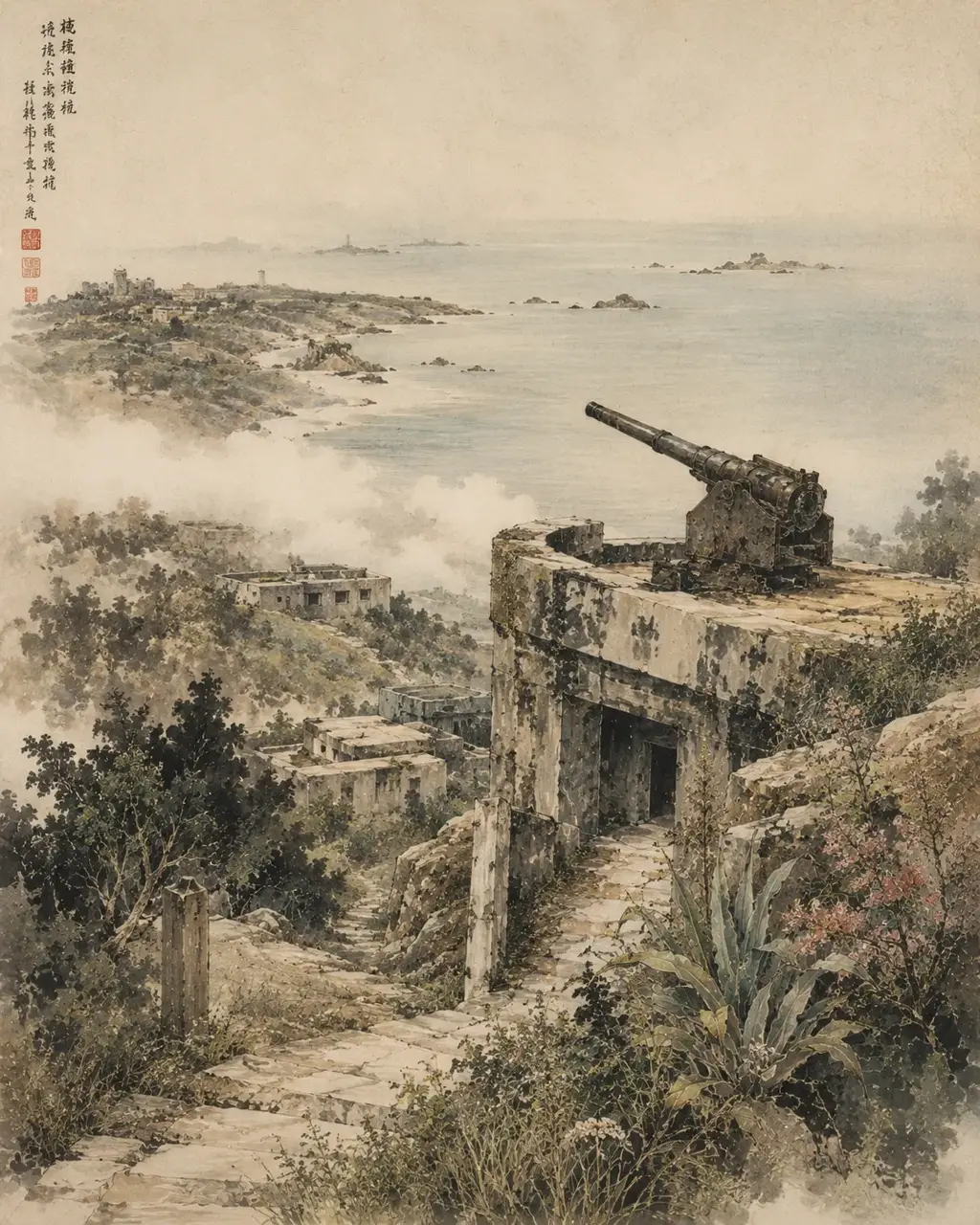
In October 1949 the Battle of Guningtou was fought on the northwest coast of Kinmen. On 23 August 1958 the artillery bombardment known in Taiwan as the 823 Bombardment began. Much of what you see on the island today goes back to those two events: anti-landing spikes slanting out of the beaches, bunkers along the shore, tunnel entrances at the foot of hills, old barracks painted in camouflage, and the windbreaks the army planted in large numbers.
The coast around Guningtou is open and empty, lined with concrete tetrapods. In Beishan village, not far from the Guningtou Battle Museum, the old Western-style house still has bullet holes from the battle in its walls.
Houpu is the old quarter of Jincheng town. The red-brick arcades of Mofan Street, the Qing-dynasty military headquarters and several small temples are all within a few streets. Shops tend to sell sorghum liquor, peanut gongtang and egg rolls side by side.
In the villages, old southern Fujian houses of red brick on granite footings stand shoulder to shoulder under swallowtail roof ridges, their walls weathered by the sea wind. Wind lion gods stand at the edges of the villages, some of them wearing red capes, put there by villagers to hold back the wind.
Sources