Lake Toba's Batak houses are carved in three colours only
Lake Toba fills a caldera left by a supervolcanic eruption about 74,000 years ago, and Samosir, the island in its middle, is roughly the size of Singapore.
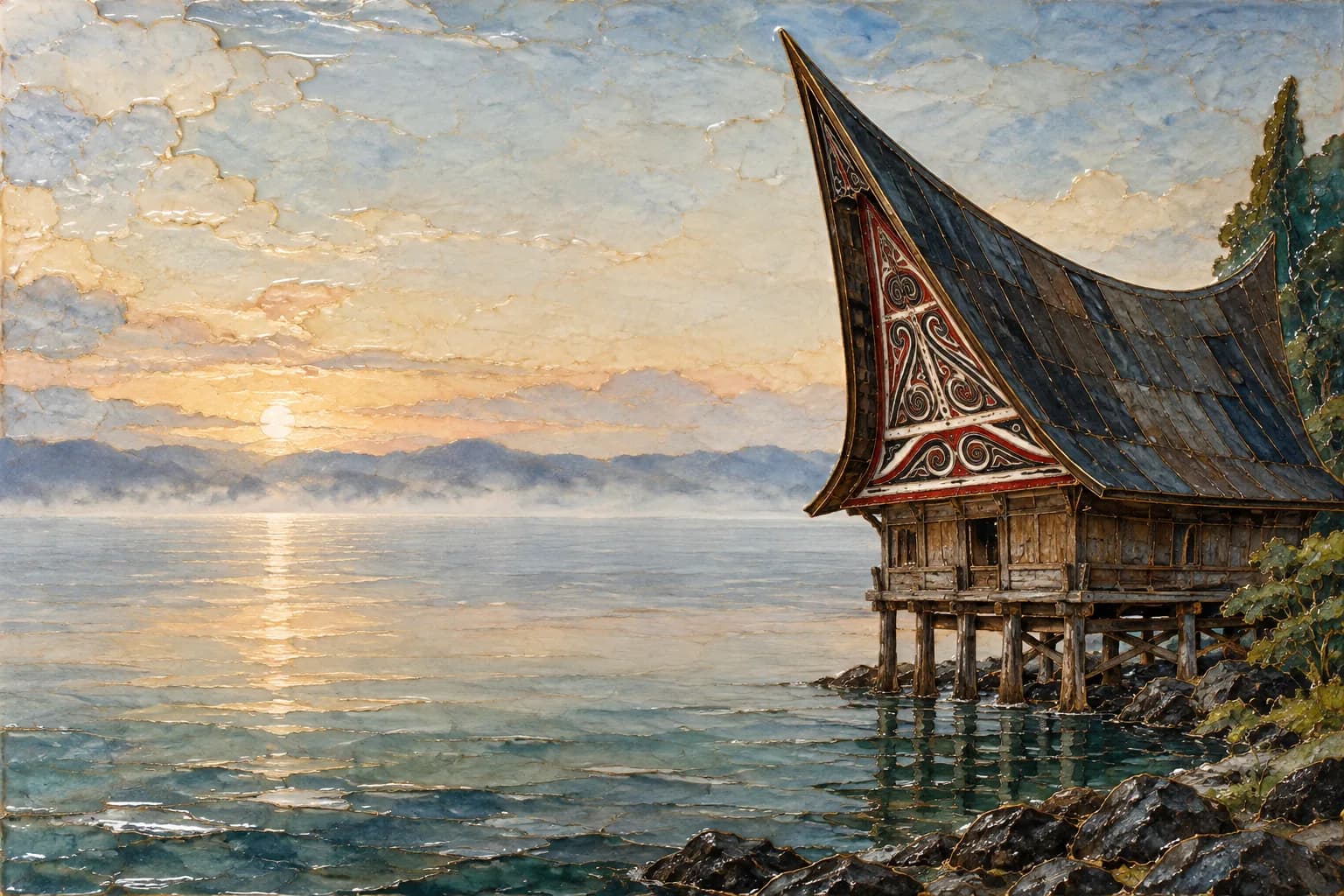
The carving on the Batak houses around Lake Toba is called gorga, and it uses only three colours, red, white and black, known together as sitiga bolit. White comes from a soft stone called tano buro and stands for the upper world; red comes from batu hula, a red stone, and stands for the middle world; black comes from plants and stands for the lower world.
Ferries cross from Parapat on the eastern shore to Tuk Tuk on Samosir, a small peninsula pushing out into the lake and lined with guesthouses and cafés. In the villages nearby you still see traditional Batak houses, raised on wooden piles, their roof ridges sweeping up at both ends and their front gables covered in carving.
Lake Toba covers about 1,100 square kilometres. It fills a caldera left when the ground collapsed after a supervolcanic eruption roughly 74,000 years ago, and the whole caldera is now a UNESCO Global Geopark. Samosir, the island in the middle, is about the size of Singapore.
High on the southern side is the viewpoint at Huta Ginjang, where paragliders often take off on clear days. The road up has plenty of bends, mostly through pine.
Lakeside restaurants often serve arsik, a whole carp cooked with turmeric and andaliman until the sauce has nearly gone. Andaliman is a relative of Sichuan pepper and leaves a slight tingle on the tongue. Ulos is the cloth the Batak weave by hand; at weddings, funerals and when guests arrive, it is draped over the shoulders of the people being honoured or given as a gift.
Sources