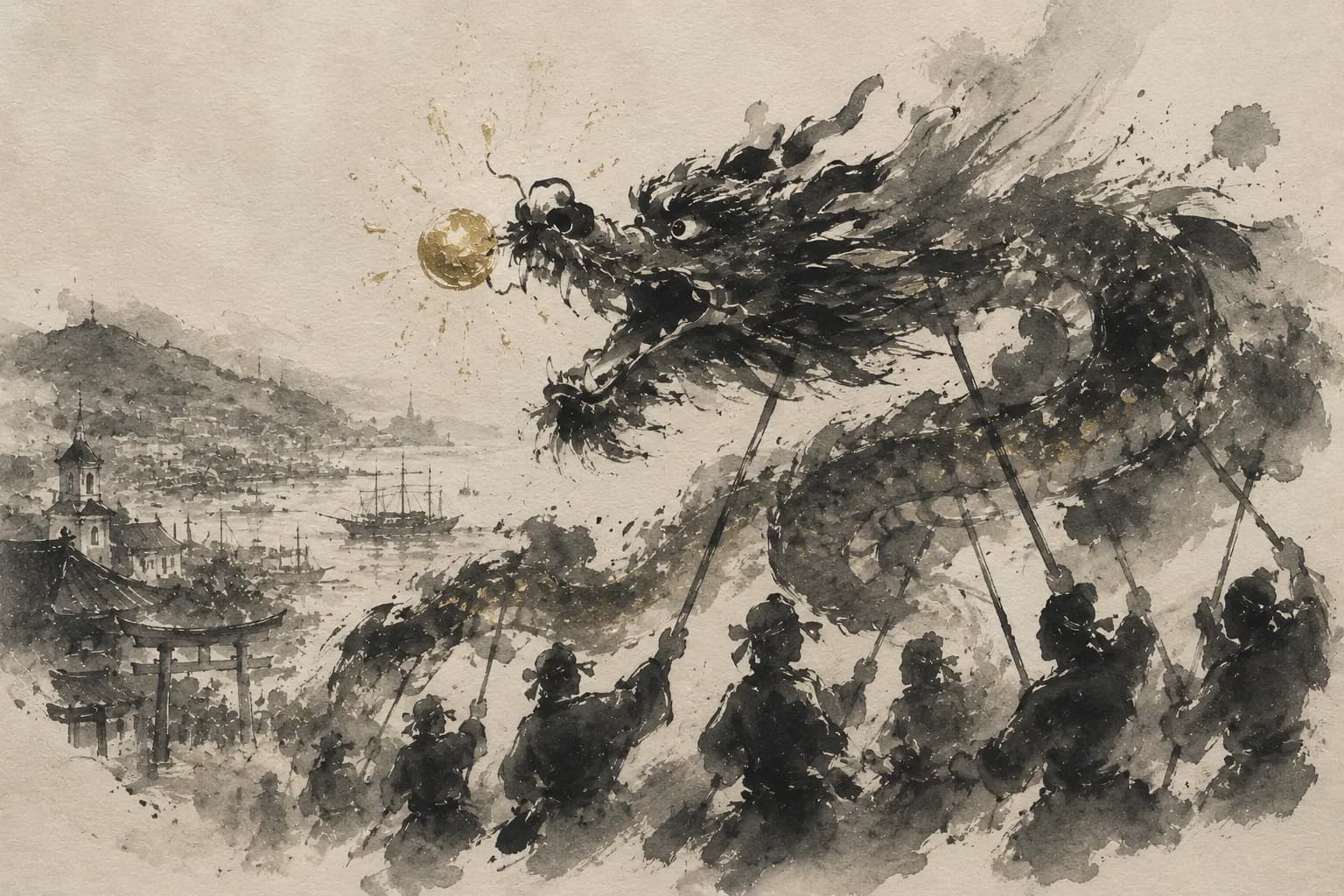
Ten poles lift a dragon after a golden ball
Related guide: Nagasaki Kunchi 2027
Motofuna-machi's Tosen Matsuri recreates trade in the era of national seclusion: children in Chinese costume dance to Chinese-style music, set off firecrackers and then pull a Chinese ship about 6 metres long through the streets. Motofuna-machi was one of six dance neighbourhoods on duty for Kunchi in 2026. According to the festival's official site, Kunchi began in 1634, when two courtesans offered the noh song Komai at Suwa Shrine, and its performances were designated an Important Intangible Folk Cultural Property in 1979.
The dances grow out of Nagasaki's history as a port. Through more than two centuries of seclusion, Nagasaki was the only port where Japan traded with the outside world, with Dutch traders confined to Dejima and Chinese merchants to the Tojin Yashiki. Chinese residents taught the dragon dance (ja-odori) to local townspeople, and in it ten performers on poles make a long dragon chase a golden pearl.
The performances are called hono-odori and are taken in turn by dance neighbourhoods (odori-cho), each of which performs only once every seven years. Besides the dragon dance there is the kawabune, where a whole wooden boat is spun around the square, and Uwa-machi's Kokkodesho, where a drum float is tossed into the air with people on it and caught again.
The main venue is the dance ground at Suwa Shrine. Facing it is a long flight of stone steps, the Nagasaka, where the audience sits and looks down as each neighbourhood performs its offering on the square.
The full guide to this festival
Nagasaki Kunchi 2027: 7–9 October at Suwa Shrine and city stages, with dragon dances and boat floats
Full guide: dates, getting there and what you can book →