Japan
Nagasaki Kunchi 2027: 7–9 October at Suwa Shrine and city stages, with dragon dances and boat floats
At a glance
- Dates
- Next: 7–9 October 2027
- Where
- Suwa Shrine's dance ground and other venues in central Nagasaki
- Getting there
- Tram from Nagasaki Station to the Suwa Shrine area
- Cost
- Chuo Park seats ¥4,500, ¥6,500 or ¥7,000 (2026)
- Limits
- Seats must be bought from each venue; there is no central box office
The 2026 edition has passed
Dates last checked: 14 October 2026
The festival
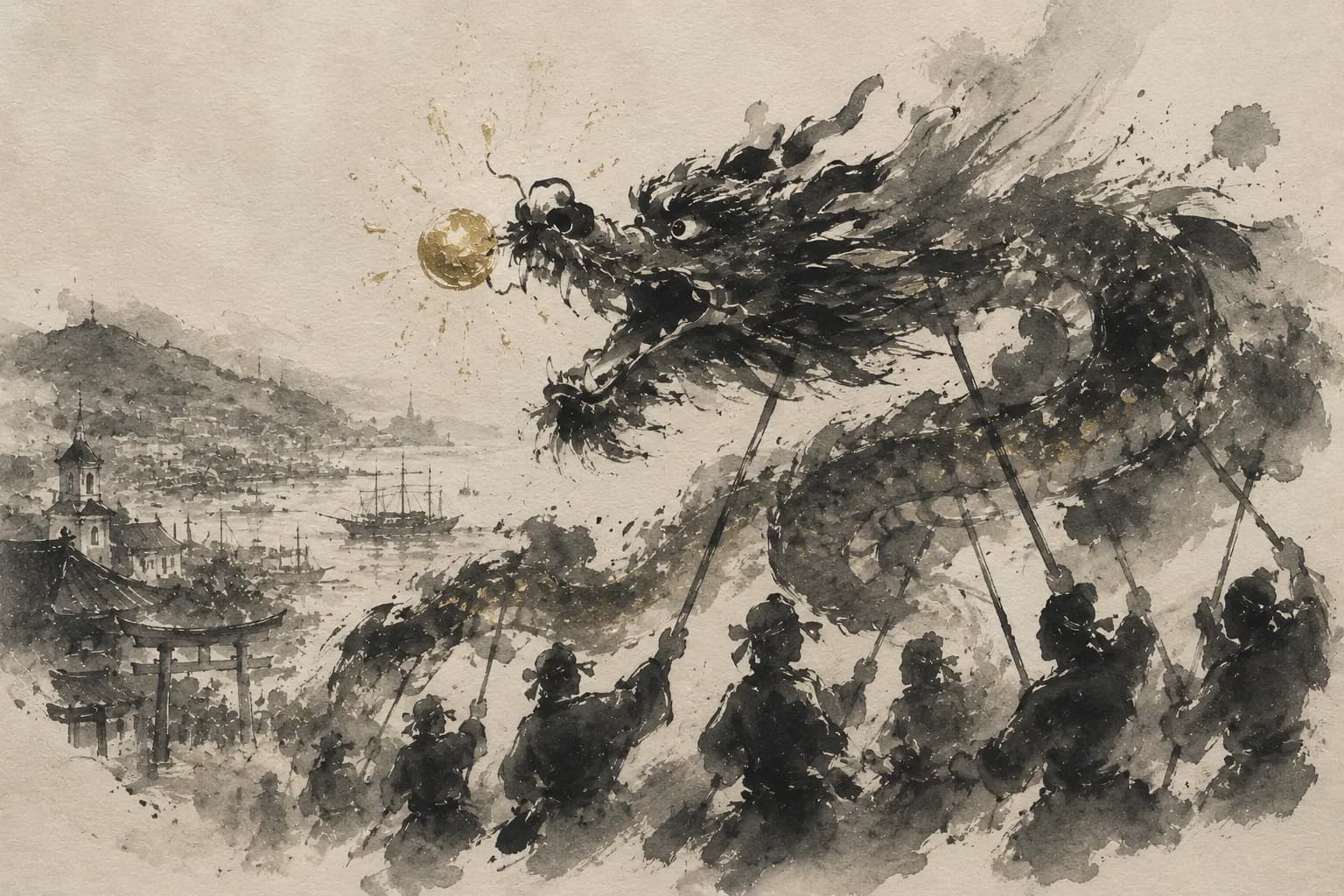
Ten poles lift a dragon after a golden ball
Motofuna-machi's Tosen Matsuri recreates trade in the era of national seclusion: children in Chinese costume dance to Chinese-style music, set off firecrackers and then pull a Chinese ship about 6 metres long through the streets. Motofuna-machi was one of six dance neighbourhoods on duty for Kunchi in 2026. According to the festival's official site, Kunchi began in 1634, when two courtesans offered the noh song Komai at Suwa Shrine, and its performances were designated an Important Intangible Folk Cultural Property in 1979.
The dances grow out of Nagasaki's history as a port. Through more than two centuries of seclusion, Nagasaki was the only port where Japan traded with the outside world, with Dutch traders confined to Dejima and Chinese merchants to the Tojin Yashiki. Chinese residents taught the dragon dance (ja-odori) to local townspeople, and in it ten performers on poles make a long dragon chase a golden pearl.
The performances are called hono-odori and are taken in turn by dance neighbourhoods (odori-cho), each of which performs only once every seven years. Besides the dragon dance there is the kawabune, where a whole wooden boat is spun around the square, and Uwa-machi's Kokkodesho, where a drum float is tossed into the air with people on it and caught again.
Booking
There are no tickets or transport to book for this page right now.
Details
There is no single box office: Suwa Shrine, Yasaka Shrine, the Otabisho and Central Park each sell their own seats, on different dates. Before buying, check which neighbourhoods perform the acts you want to see that year.
Dates and daily programme
Kunchi is the autumn festival of Suwa Shrine and runs for three days in a row.
The programme is not the same each day: neighbourhoods perform in turn at different times. If you can only go on one day, check that year's programme and pick the day with the act you most want to see.
Venues and getting there
The main venue is the Suwa Shrine dance ground, with others at the Otabisho, Yasaka Shrine and the Chuo Koen viewing stand. The dances rotate between them rather than staying in one place.
Getting there: take a tram from Nagasaki Station to the Suwa Shrine area.
Because the acts are spread across several venues, matching that year's venues and times in advance is far easier than chasing performances after you arrive.
Steps, slopes and crowds
A long flight of stone steps leads up to Suwa Shrine, the city is full of slopes, and the finales draw dense crowds. For older travellers or anyone with a stroller, a venue with seats is far easier than standing on the steps or in the crowd.
Plan the performances, then the route
Starting from Nagasaki Station and heading first to the Suwa Shrine area is the most direct route.
Nagasaki is built on hills, so moving between venues often means walking up and down. Put the performances you want in order first, and leave time between them to get around.
Where to stay: near Nagasaki Station or the tram lines
Staying near Nagasaki Station or along the city tram lines makes it easy to reach Suwa Shrine and the other venues.
Nagasaki is built on hillsides, so a base on a direct tram line means less climbing and an easy trip back after the late-afternoon performances.
Rooms and transport are tighter than usual during the festival, so the earlier you book, the more choice you have.
Costs and seat prices
Your main cost is whether you buy a seat. In 2026 the Chuo Koen stand charged ¥7,000 for ringside, ¥6,500 for S seats and ¥4,500 for A seats, and Suwa Shrine sold standing tickets on the day for ¥1,500.
The Chuo Koen stand does not refund tickets for change of plans, so settle your schedule before you buy.
How each venue sells seats
There is no single box office: each venue sells its own seats and handles its own refunds. Here is how it worked in 2026.
Suwa Shrine (the dance ground seating committee): on sale from 7am on 7 June at the committee office, then from 10 June via Ticket Pia and by phone, and also at 7-Eleven. Free seats on the Nagasaka steps need an advance application and a lottery ticket.
Yasaka Shrine: online bookings from 10 June, phone bookings on weekdays from 18 June. Otabisho: phone bookings only, from 13 July. Chuo Koen viewing stand (Nagasaki Traditional Performing Arts Promotion Association): from 10am on 3 August via Ticket Pia and 7-Eleven, with no phone sales.
The signature acts
Each neighbourhood treats its year on duty as a major event and prepares for it accordingly.
The best-known act is the dragon dance (ja-odori), performed by Chikugo-machi among others. There is also the kawabune, a whole wooden boat spun around the square, and Uwa-machi's Kokkodesho, where a drum float is tossed into the air with people on it and caught again.
When taking photos, keep out of the aisles and the performers' paths.
Where the dragon dance comes from
The dragon dance comes out of Nagasaki's history as a port. For more than two centuries of the Edo period Japan traded abroad only through Nagasaki: the Dutch lived on Dejima and Chinese merchants in the Tojin Yashiki.
Chinese residents taught the dragon dance to local townspeople, and its steps still show that foreign influence. The Dejima and Tojin Yashiki sites are both in the city and fit into the same trip.
How Kunchi differs from other festivals
The main difference is where the acts come from: the dragon dance and the Tosen Matsuri draw directly on Nagasaki's dealings with China and the Netherlands during the seclusion era, which is rare among Japan's autumn festivals.
The other is the rotation. A neighbourhood's act only comes back after several years, so if you want to see a particular one, check which neighbourhoods are performing that year. On the official site, for example, both Chikugo-machi and Suwa-machi perform a dragon dance, and Aburaya-machi and Enokizu-machi a kawabune.
Good to know
- Location
- Venues include the Suwa Shrine dance ground, the Otabisho, Yasaka Shrine and the Chuo Koen viewing stand, with the dances rotating between them.
- Transport
- You can take the tram from Nagasaki Station to the Suwa Shrine area.
- Rotation
- The performances, called hono-odori, are taken in turn by dance neighbourhoods (odori-cho), each of which performs once every seven years. Six neighbourhoods took part in 2026.
- Main acts
- Signature acts include the dragon dance (ja-odori), the kawabune, where a whole wooden boat is spun around, and Uwa-machi's Kokkodesho, where a drum float is tossed into the air with people on it.
- Tickets
- Each venue sells its own seats; in 2026 sales opened in stages from June to August.
FAQ
5
Where is Nagasaki Kunchi held?
The main venue is the Suwa Shrine dance ground, with others at the Otabisho, Yasaka Shrine and the Chuo Koen viewing stand. Trams run from Nagasaki Station to the Suwa Shrine area.
Where can I buy seats?
Each venue sells its own. In 2026, Suwa Shrine sold stand seats from 7 June at its committee office and from 10 June via Ticket Pia, by phone and at 7-Eleven. Yasaka Shrine took online bookings from 10 June, the Otabisho phone bookings from 13 July, and the Chuo Koen stand sold via Ticket Pia and 7-Eleven from 3 August at ¥4,500–7,000, with no refunds for change of plans. Free seats on Suwa Shrine's Nagasaka steps need an advance application and a lottery ticket.
What are the main acts?
The performances are called hono-odori and are taken in turn by the dance neighbourhoods. The signature act is the dragon dance; there is also the kawabune, a whole wooden boat spun around, and Kokkodesho, where a drum float is tossed into the air with people on it.
What is the story behind the dragon dance?
In the Edo period Japan closed itself off, and Nagasaki was the only port open to Dutch and Chinese ships. Chinese residents taught the dragon dance to local townspeople, and its steps still show that foreign influence.
Can I watch without a seat ticket?
Yes. Suwa Shrine sells standing tickets on the day for ¥1,500 each, and the Nagasaka steps facing the dance ground have free seats allocated by advance lottery. The long stone steps in front of the shrine get crowded, so take them slowly.
Read next