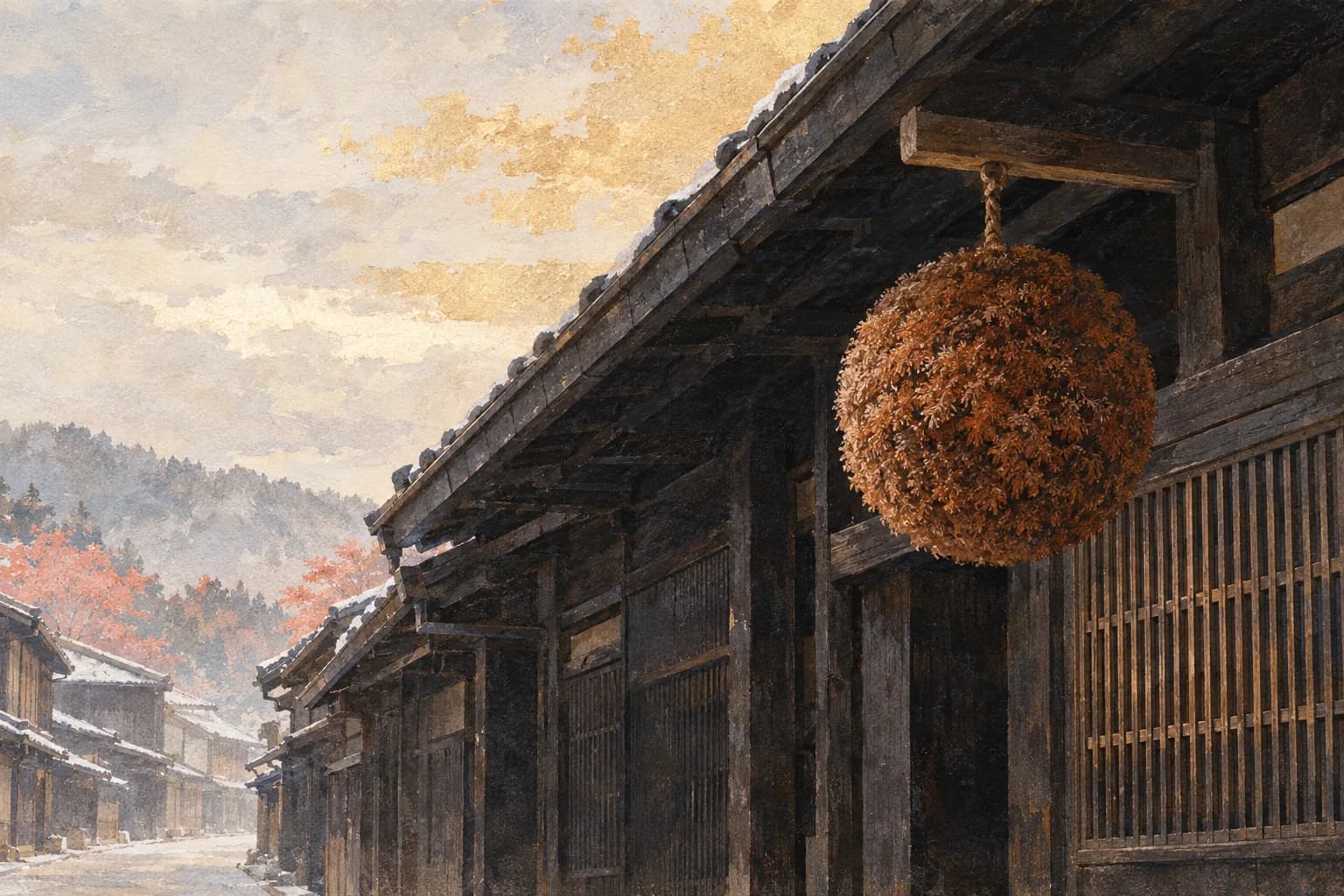
Takayama's cedar balls hang green over the brewery doors and fade to brown
Takayama was ruled directly by the shogunate in the Edo period; its old office, Takayama Jinya, still stands, and morning markets set up in front of it and along the Miyagawa.
Several breweries in Takayama's Sanmachi quarter hang a sugidama under the eaves: a ball of cedar foliage, also called sakabayashi. The custom is said to come from Omiwa Shrine in Nara, dedicated to the god of sake, where the cedars on Mount Miwa are held sacred. A ball hung when the new sake is pressed is green, then slowly withers, and by autumn it has turned brown, in time for hiyaoroshi, the sake held back over the summer.
The old streets of Sanmachi are lined with wooden merchant houses whose eaves reach well over the street, their lattice windows finely made; Hida carpenters have had a name across Japan for centuries. Behind the glass sit Hida Shunkei lacquerware and pottery bowls, and many shops sell miso and pickles.
For hoba miso, miso and spring onion are spread on a dried magnolia leaf and set over a small charcoal burner until the miso bubbles and scorches at the edges, then eaten with rice. In the old town Hida beef is served as nigiri or grilled on skewers at shop fronts, and the breweries pour cold local sake to taste.
Takayama sits in the mountains of Hida. In the Edo period it was governed directly by the shogunate, and the old administrative office, Takayama Jinya, still stands and is open to visitors. Every morning there are two markets, one in front of the Jinya and one along the Miyagawa River, selling vegetables, pickles, miso and flowers.
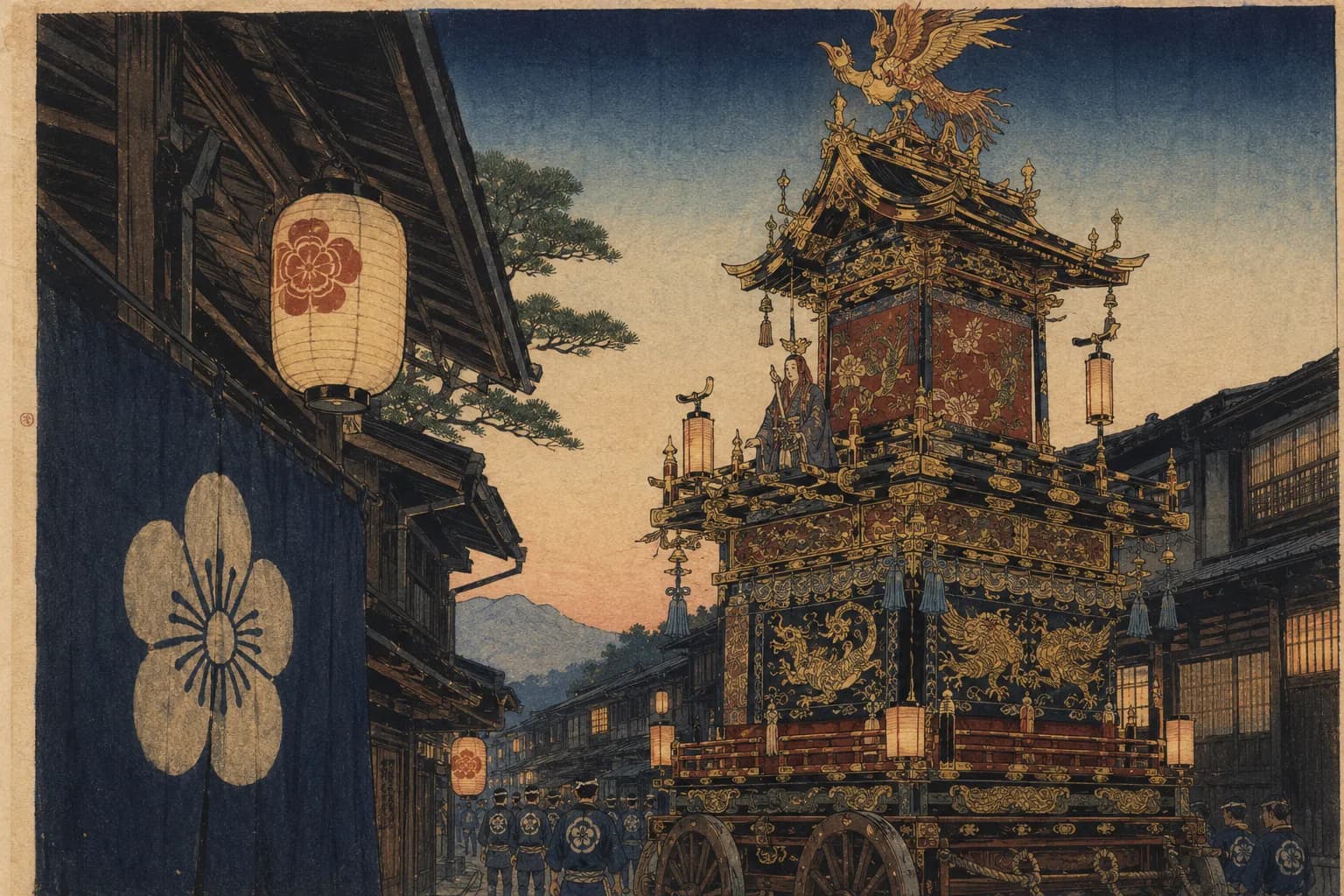
The Miyagawa runs right beside the old town, crossed by the red-lacquered Nakabashi bridge. At the Takayama Festival, held in April and again in October, the wooden yatai floats are drawn through these streets.
Festivals in the same city
Takayama Festival 2027: spring Sanno Matsuri at Hie Shrine, 14–15 April, with floats and karakuri puppets
Full guide: dates, getting there and what you can book →
Tickets and transport you can book
These are affiliate links: if you book through them, VoucherData may earn a commission. You pay the same price.
Shirakawa-go & Takayama, Gifu
Shirakawa-go & Takayama day tour from Nagoya
Bus tour from Nagoya (08:15–19:30) covering Gujo Hachiman, Takayama and Shirakawa-go. Chinese, English and Japanese guiding; free cancellation up to 48 hours before.
See prices
Sources