Japan
Takayama Festival 2027: spring Sanno Matsuri at Hie Shrine, 14–15 April, with floats and karakuri puppets
At a glance
- Dates
- Next: 14–15 April 2027
- Where
- Takayama old town, Gifu; the spring festival centres on Hie Shrine
- Getting there
- Limited-express train from Nagoya (2+ hours), then 12 minutes on foot
- Cost
- Not listed
- Limits
- No drones during the festival and no smoking on old-town streets
The 2026 edition has passed
Dates last checked: 14 October 2026
The festival
Two karakuri children leap bar to bar and land on Hotei's shoulders
The spring festival brings out 12 floats and the autumn festival 11. The spring Sanno Matsuri belongs to Hie Shrine in the south of the old town, and the Hachiman Matsuri on 9–10 October to Sakurayama Hachimangu in the north, each with its own floats and route.
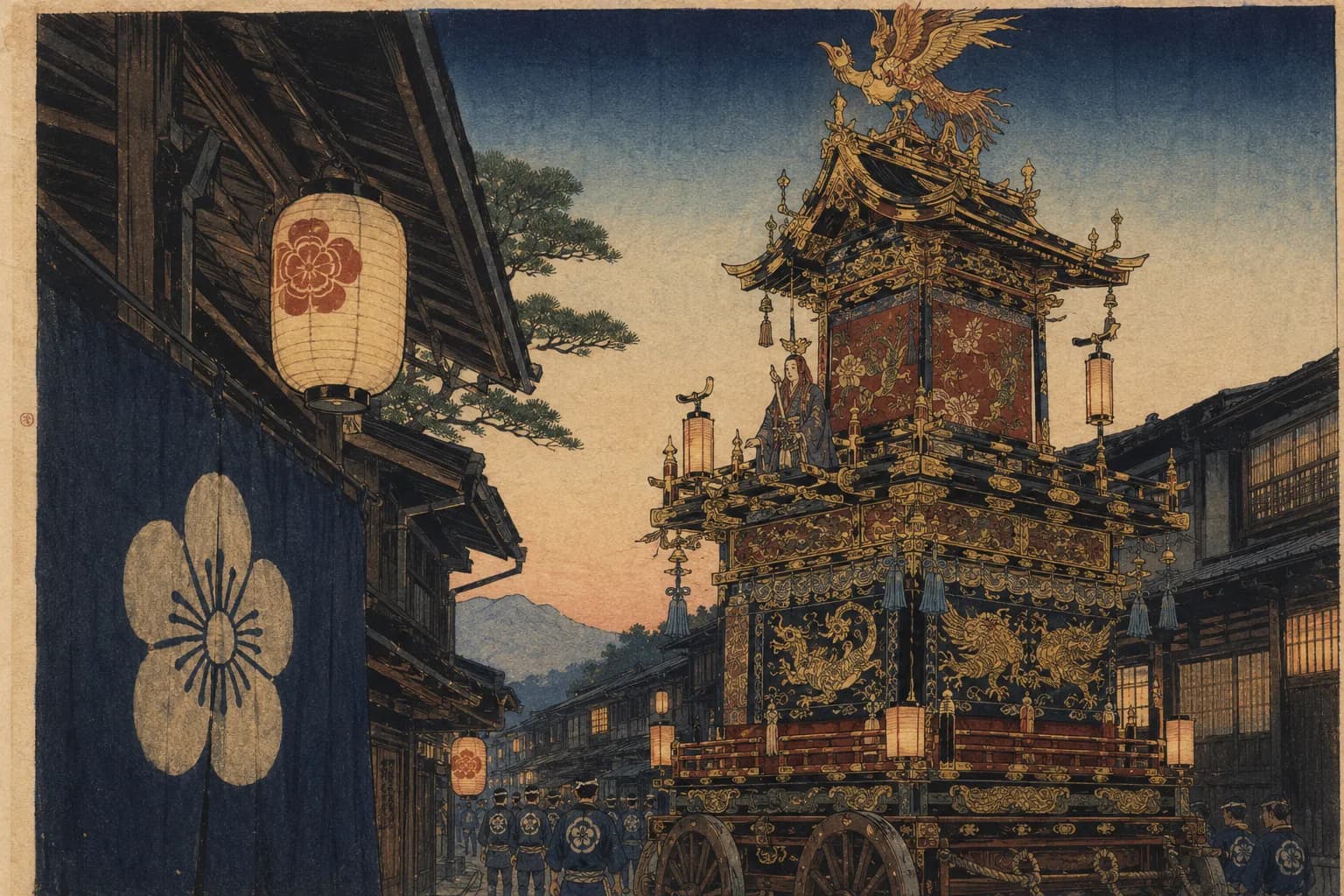
Each float is a three-storey wooden structure in black lacquer and gold, covered in carved dragons, phoenixes and scrollwork and in metal fittings. Hida is mountainous with little farmland and has long been known for its carpenters, who were once summoned to build palaces and temples in the old capital. The Takayama floats come out of that tradition.
Only 4 of the 23 floats still carry karakuri puppets: Sanbaso, Shakkyotai and Ryujintai in spring, and Hoteitai in autumn. The puppeteers sit inside the float, each working one small part of the figure by rope, with no electricity or motors involved. On Hoteitai two child figures leap from bar to bar and finish standing on Hotei's shoulders; Ryujintai plays out a dragon god that a child has made drunk and sealed in a jar, and which wakes and dances in fury.
Booking
These are affiliate links: if you book through them, VoucherData may earn a commission. You pay the same price.
Prices and ratings checked 13 Oct 2026
Transport
Nagoya, Takayama and Hokuriku
JR Takayama-Hokuriku Area Tourist Pass (5 days)
Covers the Limited Express Hida from Nagoya to Takayama, plus designated JR trains and buses in the area for 5 consecutive days, including the bus from Takayama to Shirakawa-go.
See plans
Tickets and tours
Shirakawa-go & Takayama, Gifu
Shirakawa-go & Takayama day tour from Nagoya
Bus tour from Nagoya (08:15–19:30) covering Gujo Hachiman, Takayama and Shirakawa-go. Chinese, English and Japanese guiding; free cancellation up to 48 hours before.
from NT$1,789
See prices
Details
Plan around one night: the lantern-lit yoi-matsuri runs only on the first evening of each festival. Everything is watched standing, and in rain events are scaled back or cancelled with no makeup date.
Dates: spring Sanno Matsuri and autumn Hachiman Matsuri
The Takayama Festival is two separate festivals, not one event held twice. The spring Sanno Matsuri is held every year on 14–15 April as the annual rite of Hie Shrine, in the south of the old town, with 12 floats. The autumn Hachiman Matsuri is held every year on 9–10 October as the annual rite of Sakurayama Hachimangu, in the north of the old town, with 11 floats.
Both 2026 festivals have taken place. The next is the spring festival on 14–15 April 2027, and its detailed schedule has not been published yet. If there is a particular float you want to see, check which festival it belongs to.
Japan's three great float festivals
The Sanno and Hachiman festivals together make up the Takayama Festival, counted with Kyoto's Gion Matsuri and the Chichibu Night Festival among Japan's three great float festivals. Takayama City's materials also call it one of Japan's three most beautiful festivals.
Getting there: Nagoya to Hida-Takayama
The festival takes place in the old town of Takayama, Gifu Prefecture. In spring it centres on Hie Shrine and the Otabisho, about 12 minutes on foot from JR Takayama Station.
Most people come by limited express from Nagoya, a ride of a little over two hours. If you drive, the old town is closed to traffic during the festival; at the 2026 spring festival there was a free temporary car park at Takumi-ga-oka with a free shuttle bus to the Takayama Civic Cultural Hall.
How to watch
There are no viewing seats, and the official pages list no viewing fee. The karakuri shows and the night parade are watched standing, the organisers may close off viewing areas when they get too crowded, and bicycles and kick scooters are no use in the crowds. For the autumn festival the organisers warn about heatstroke while standing for the karakuri, and the spring night parade happens in the cold after dark. The daytime float displays can be seen while walking along the street, without holding one spot for long.
Planning: transport, where to stay and the night festival
Where to stay: in or within walking distance of the old town, so you don't have to rush for a train after the night parade. Rooms for the two festival days are in high demand, so book once your dates are fixed.
By day: the float displays start at 9:30 in spring and 9:00 in autumn. At the 2026 spring festival the karakuri shows ran at 10:00 and 14:00 on both days, about 50 minutes each.
At night: the yoi-matsuri is on the first night only. If you stay in the old town, you can go back to your room for a warmer layer after the daytime displays and head out again.
What to look for on the floats
The floats are best seen up close while they are parked on display, when you can walk round the carvings and metal fittings on the black-and-gold bodies. In spring they line up along Shinmeicho-dori and nearby streets, and in autumn along the approach to Sakurayama Hachimangu and in its grounds.
Some floats carry karakuri puppets worked with strings. There are two karakuri shows a day: about 20 minutes each at the 2026 autumn festival and about 50 minutes in spring.
The yoi-matsuri: floats by lantern light
The yoi-matsuri is held on the first night of each festival only: 14 April in spring and 9 October in autumn. Each float is hung with about a hundred lanterns and paraded through the old town.
The official viewing rules: stay off the roadway while the floats pass, and don't cross or follow the procession.
Crowds, weather and etiquette
Crowds: the parades are concentrated in the old town's narrow streets, and the organisers may restrict access to viewing areas when they get too crowded.
Weather: in rain the events are scaled back or cancelled and not rescheduled. April nights in Takayama are still cold, so bring a warm jacket if you plan to stay for the yoi-matsuri.
Etiquette: the floats are Important Tangible Folk Cultural Properties, so don't touch them. Drones are banned during the festival, smoking on the street is banned in the old town, and you should follow the security staff's directions.
The old town's Edo-era townhouses
Takayama's old town keeps rows of Edo-era wooden townhouses, and the floats pass right between them. The Sanmachi old streets and the Miyagawa morning market are both within walking distance.
Good to know
- Location
- The old town of Hida-Takayama, Gifu Prefecture; the procession winds through narrow lanes and street corners
- Shrines
- The spring festival is the regular rite of Hie Shrine; the autumn festival belongs to Sakurayama Hachimangu, with different floats and routes
- Yatai floats
- Three-storey wooden floats in black lacquer and gold. All 23 were designated Important Tangible Folk Cultural Properties in 1960, and some carry karakuri puppets
- Night festival
- First night of each festival only: the floats are hung with about a hundred lanterns each and paraded through the old town, 18:00–20:30 on 14 April at the 2026 spring festival
- Getting there
- Most go by limited-express train from Nagoya, about two-plus hours; the old town can be explored on foot
FAQ
5
What is the difference between the spring Sanno Matsuri and the autumn Hachiman Matsuri?
The spring Sanno Matsuri is the regular rite of Hie Shrine, held in April; the autumn Hachiman Matsuri belongs to Sakurayama Hachimangu and is held in October. The two belong to different shrines and different seasons, and the floats brought out and the procession routes also differ.
What should you look for on the Takayama floats?
Each float is a three-storey wooden structure in black lacquer and gold. There are 12 for the spring festival and 11 for autumn, and all 23 were designated Important Tangible Folk Cultural Properties in 1960. Only four still carry karakuri puppets (Sanbaso, Shakkyotai and Ryujintai in spring, Hoteitai in autumn); on Hoteitai two child figures leap from bar to bar and land on Hotei's shoulders.
Where is the Takayama Festival held, and how do you get there?
It takes place in the old town of Takayama, Gifu Prefecture. Most people come by limited express from Nagoya, a ride of a little over two hours. From JR Takayama Station it is about a 12-minute walk to the spring festival area around Hie Shrine and the Otabisho, and the old town is small enough to cover on foot.
How is the night festival different from the daytime procession?
By day the floats are on display and the karakuri puppets perform. The yoi-matsuri takes place on the first night only, when the floats are hung with about a hundred lanterns each and paraded through the old town. It gets cold after dark, so bring a jacket if you are staying for it.
Besides watching the floats, what else can you do during the day?
Beyond the floats, the Sanmachi old streets and the Miyagawa morning market are both in the old town and within walking distance.
Date sources
12
- en.wikipedia.org · Takayama Festival
- hidatakayama.or.jp
- japan.travel (1)
- japan.travel (2)
- online.bunka.go.jp
- chichibuji.gr.jp · Yomatsuri
- city.takayama.lg.jp · Panfu.pdf
- hidatakayama.or.jp · Harunotakayamamatsuri
- hidatakayama.or.jp · Akinotakayamamatsuri
- kankou-gifu.jp · Detail 8488
- mlit.go.jp
- ja.wikipedia.org
Read next